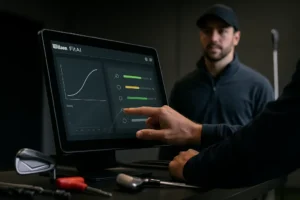
Too little loft is one of the most common driver fitting mistakes because it looks logical before the ball is hit. A lower number on the sole can feel faster, stronger, and more “player-like.” In the bay, though, the club does not care about ego. It cares about delivered loft, strike location, attack angle, spin, and whether the ball stays in the air long enough to produce useful carry.
That is why a good fitting starts with ball flight and launch-monitor data, not the number stamped on the head. A player can swing hard and still launch the ball too low. Another player can own a driver marked 10.5 degrees and deliver far less effective loft at impact. The fitting job is to separate what the club says it is from what the golfer actually presents to the ball.
Why Too Little Loft Shows Up In Fittings
In a fitting bay, too little loft rarely announces itself with one obvious symptom. It can look like a flat flight, weak carry, low launch, heel or toe strikes that fall out of the air, or a player trying to “help” the ball up with a swing change that makes contact worse. The mistake often starts before the appointment, when a golfer books a driver fitting with a specific loft already in mind.
Too Little Loft And The Launch Window
On July 8, 2026, MyGolfSpy warned that lower-loft drivers can hurt the launch and spin window when golfers do not deliver enough dynamic loft at impact, causing the ball to start low and lose carry potential MyGolfSpy loft analysis. That does not mean every player needs more loft. It means loft has to be tested against the actual delivery pattern.
The key word is “dynamic.” Static loft is the measured loft of the head. Dynamic loft is what the club presents at impact. A golfer with a downward or level attack angle, forward shaft lean, or a strike low on the face may deliver less loft than expected. That player may see a ball that launches flat even when the driver looks reasonable on paper.
The Number On The Sole Can Mislead
Golf Digest made the same fitting point in its November 17, 2023 piece on driver loft: buying based only on the number on the sole can fool golfers because head design, dynamic loft, and attack angle shape the real flight Golf Digest loft report. Two drivers with the same printed loft can launch differently, and two golfers using the same head can produce very different flights.
This is why better fitters avoid judging a player from clubhead speed alone. Speed matters, but it does not solve the full problem. A fast player with poor launch conditions may leave carry on the table. A moderate-speed player with a positive delivery and centered strike may fit into a different loft than expected. The answer comes from testing, not from matching a swing-speed chart without context.
How Fitters Diagnose Too Little Loft
How fitters diagnose too little loft starts with a baseline. The fitter wants to see the golfer’s current driver, usual ball flight, strike pattern, and delivery. That first set of shots tells more than the golfer’s preference. If launch is consistently flat, carry is not matching ball speed, and the player is trying to add height with hand action, the loft question moves to the front of the session.
A fitter will usually compare the gamer driver against different loft settings or heads while watching several data points together. No single number should run the entire decision. Launch angle without spin can mislead. Spin without strike location can mislead. Ball speed without peak height and descent can make a poor fit look powerful for a few swings.
- Launch angle: Is the ball starting high enough for the player’s speed and delivery?
- Spin: Is the ball staying in the air, or is it dropping too early?
- Attack angle: Is the player hitting up, level, or down with the driver?
- Dynamic loft: How much loft is actually delivered at impact?
- Strike location: Is impact high, low, heel-side, toe-side, or centered?
The cure for too little loft is not always as simple as turning a hosel sleeve higher. Hosel changes can also influence face angle and player aim. A different head profile, shaft feel, tee height, or ball position may change delivery enough to alter the loft recommendation. The best fitting decision is the one that produces a repeatable pattern, not one perfect launch-monitor shot.
For players who want more background before booking, our piece on correct loft selection explains why loft should be matched to impact and ball flight rather than chosen by reputation.
What Golfers Get Wrong Before Booking
The booking process can create the mistake before the fitting starts. Some golfers arrive saying, “I need a 9-degree head,” because a tour player uses one or because their previous driver had that number. Others believe higher loft means weaker shots. Neither assumption is reliable. A fitter is trying to build the most playable launch window for that golfer, not copy another player’s setup.
Bring The Driver You Actually Use
A fitter needs the current driver, not just a description of it. The gamer shows length, loft setting, shaft, grip, wear marks, and the strike pattern the player has been living with. Even if the club is a poor match, it gives the fitter a reference point. Without that baseline, the session can turn into random testing instead of a clear comparison.
Golfers should also bring the ball they normally play if possible. Ball model can influence spin and launch enough to affect a driver test. The point is not to chase a lab-perfect setup. The point is to test equipment in conditions that resemble the golfer’s real rounds.
Do Not Book Around A Loft Number
A better booking note is: “My driver flight is low,” or “I’m not carrying it as far as expected,” or “I want to test loft and launch.” That gives the fitter room to evaluate. If the appointment starts with a locked-in number, the test can get biased. The best fit might be more loft, a different head, a setting change, or a delivery adjustment that belongs with a teaching professional rather than a club change.
Readers who follow other sports across our network, including the intriguing insights shared at Dashers Hockey, will recognize the same principle: the right setup depends on the athlete’s movement pattern, not just the equipment label.
How Loft Affects Scoring Decisions
Driver fitting is not only about the longest shot in the session. It is about the shot pattern a golfer can take to the first tee. If the driver launches too low, the player may aim away from trouble, swing harder to create height, or accept shorter carry over bunkers and corners. Those choices can affect strategy on par 4s and par 5s.
A higher-launching fit may help some golfers carry hazards or hold a tighter dispersion window, but that result is player-specific. No fitter should promise a fixed yardage gain or a lower score from a loft change. The honest goal is better launch conditions, more usable carry, and a driver flight the golfer can repeat under normal playing pressure.
Loft also changes confidence. A player who sees the ball climb properly may stop trying to manufacture height. That can free up a more neutral swing. Still, the club cannot fix every delivery issue. If the golfer is adding or removing loft with extreme hand action, a fitter may recommend a lesson before or after the build decision.
Booking A Fitting Around Too Little Loft
Treat too little loft as a testable question, not a fixed diagnosis. When booking, ask whether the session will measure launch, spin, attack angle, dynamic loft, and strike location. Ask whether the fitter can test multiple loft settings rather than one head in one setting. Ask how many shots will be used before making a decision, because a small sample can hide the real pattern.
The best driver fitting conversations are practical. Tell the fitter your normal miss, your preferred ball flight, the courses you play, and whether you struggle to carry specific hazards. Then let the data challenge your assumptions. If the right answer is more loft, that is not a step backward. It is a move toward a driver that fits the way you actually deliver the club.
Too little loft remains common because it appeals to the eye and the ego before it fails in flight. A fitting replaces that guesswork with measured launch, spin, strike, and delivery. For many golfers, that is the difference between owning a driver with a desirable number and playing a driver that produces a more useful ball flight.