Beginner Irons 2026 should be chosen with the same mindset a good fitter uses in the bay: start with contact, launch, ball flight, and gaps before getting distracted by finish, brand loyalty, or one flushed 7-iron. New golfers need help on imperfect strikes, but the right help is not identical for every player.
Some beginners fight a slice. Some struggle to get the ball airborne. Some have enough speed but hit the heel and toe too often. A useful iron set protects those misses without making the club so light, long, or draw-biased that it creates a new problem. That is why a beginner fitting does not need to be complicated, but it does need to be honest.
Beginner Irons 2026 Start With Fit
Why Beginner Irons 2026 Are Not One-Size
The research supplied for this guide identified several 2026 beginner-friendly irons as already released and available as of September 21, 2026. That matters because this is not a preview of future products. It is a practical fitting discussion around clubs golfers can compare now in a hitting bay or shop.
For new players, “forgiving” usually means a head that keeps ball speed and launch from falling apart on off-center strikes. Cavity-back construction, perimeter weighting, wide soles, lower centers of gravity, and hybrid-like long iron shapes are common tools in this category. The point is not to hide every miss. The point is to turn the average miss into a playable shot more often.
Length and lie angle deserve an early check. The research notes point out that standard specs fit many golfers in the broad middle of the height range, but players outside that range should not assume standard is safe. GOLF.com’s 2026 iron fitting coverage also stresses matching iron choice to the golfer rather than picking from a shelf by reputation alone, as seen in its 2026 irons guide.
Start With The Miss You Actually Hit
A slicer may need offset or draw bias. A slower-speed player may need lighter total weight, graphite shafts, and higher-launching heads. A golfer who hits heavy shots may need to pay close attention to sole width and turf interaction. If the ball already starts left and curves farther left, a draw-biased iron may make the pattern worse.
This is where a short fit is more useful than a long spec sheet. Hit enough shots to see the pattern. Keep the worst strikes in the sample. A beginner does not need a perfect swing for the data to help; in fact, the miss pattern is the data.
Top Models Worth Testing
Forgiveness First, Then Feel
Low Handicap Golf’s 2026 beginner iron review placed the TaylorMade Qi Max high for new golfers, citing distance, forgiveness, slice help, FLTD CG, ECHO Damping, and progressive offset in its beginner iron picks. That does not mean it fits every beginner, but it explains why it belongs in a test group for players who need launch and directional help.
Cleveland Launcher XL Halo Full-Face is another model that makes sense for golfers who want maximum help on contact. The research notes identify it as a strong option for inconsistent strikes, especially in longer irons, with full-face grooves and very wide soles among beginner designs. That type of head can be especially useful for players who do not yet deliver the club consistently.
| Model | Best Fit Clue | Fitting Watch-Out |
|---|---|---|
| TaylorMade Qi Max | Beginner needing forgiveness, launch, and slice help | Confirm draw bias does not overcorrect the start line |
| Cleveland Launcher XL Halo Full-Face | Inconsistent contact and long-iron confidence issues | Check whether the wide sole fits the player’s turf strike |
| Ping G440 | Player seeking easy launch and long-term brand familiarity | Compare shaft weight and lie angle against strike pattern |
| Wilson Launch Pad 2 | Golfer wanting easy launch and help through the turf | Do not choose only on price; test dispersion |
| TaylorMade Stealth HD | Slicer who benefits from a draw-biased, hybrid-iron shape | A hook-prone player should be careful |
| Takomo 101 MKII | High-handicap player considering a direct-to-consumer set | Make sure specs can be checked before committing |
| Srixon ZXiR HL | Golfer who wants game-improvement help in a premium-looking head | Test launch and height, not just address look |
| Cobra AIR-X | Lighter-built or slower-speed beginner needing less total weight | Too light can hurt tempo for some players |
Do Not Buy The Longest 7-Iron Alone
Beginner Irons 2026 can look impressive in a bay if one club flies farther than the rest. Distance matters, but only if the set still produces usable gaps. A strong-lofted 7-iron that flies far but leaves no height or stopping power may not help a new golfer score. A shorter carry with better launch, cleaner turf contact, and tighter left-right dispersion can be the smarter fit.
If you are getting ready for your first appointment, our beginner club fitting guide explains what to bring and how to read the session without overreacting to one swing.
Launch-Monitor Checks For New Golfers
Numbers That Matter Early
A good beginner iron test should track carry distance, launch angle, peak height, spin consistency, descent angle, ball speed retention on misses, and left-right dispersion. The fitter should also watch where contact happens on the face. A club that keeps a toe miss in play has value for a new golfer, even if it does not win the single best-shot contest.
For a player with slower speed, graphite can make sense because it can reduce total weight and fatigue. The research notes describe graphite as a better match for slower swingers or golfers still building strength, while steel can feel more stable for players with moderate speed and steadier tempo. Shaft choice should come from delivery, not age alone.
Gapping Is A Scoring Skill
Beginner Irons 2026 should create clear carry gaps through the set. Many new golfers do not need a traditional 4-iron or even a 5-iron if those clubs fly too low or too close together. A hybrid-style iron, hybrid, or higher-lofted fairway wood may cover that distance better. The goal is to build a set where each club has a job.
Watch the transition from the longest iron into hybrids or fairway woods, then from pitching wedge into wedges. Beginners often lose strokes because one end of the set is crowded while another has a large yardage hole. A launch monitor can show that quickly, but range and course feedback still matter.
Buying Beginner Irons 2026 Without Guesswork
Use A Short Test Plan
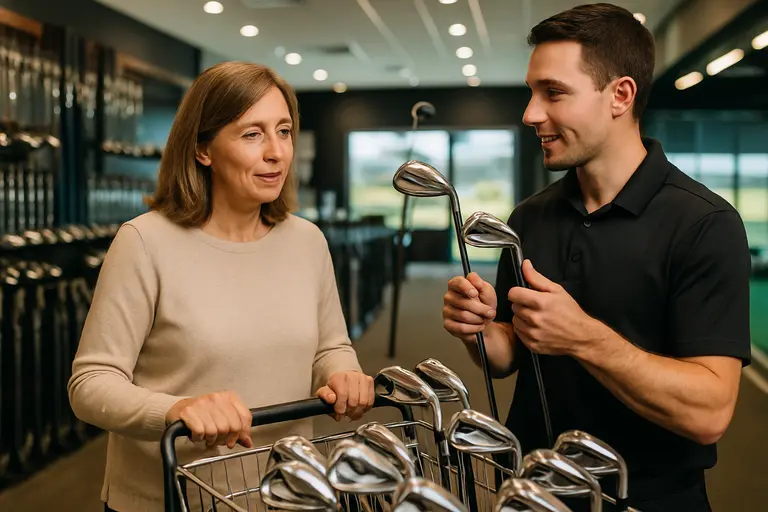
A Beginner Irons 2026 fitting does not have to be a two-hour session with every head on the wall. Start with three categories: a traditional game-improvement cavity, a hybrid-style iron, and a lightweight model. Hit enough shots with each to see the poor strikes, not just the best ones.
- Check contact first: face location and turf strike explain many launch and direction problems.
- Compare carry gaps: the best set should produce useful distance spacing, not only one long club.
- Match shaft weight to tempo: too heavy can cost speed; too light can hurt timing.
- Verify lie angle: directional misses can come from fit as well as swing path.
- Keep the long end flexible: hybrids or hybrid-style irons may beat low-flying long irons.
Do not let a clearance price decide the set by itself. The research notes mention that some 2026 pricing was tied to June 2026 stock conditions, and that kind of number can move. A good deal is only good if the head, shaft, length, and lie make sense for the player holding the club.
Brand Names Help, But Ball Flight Decides
TaylorMade, Cleveland, Ping, Wilson, Takomo, Srixon, and Cobra all appear in the supplied research because each offers a beginner-friendly path. The fit question is more specific: which one keeps your common miss playable and gives you enough height to hold greens as your contact improves?
For readers interested in culture and other sports, Banat Zayed offers a diverse perspective within the same network, focusing on a wide range of topics outside of golf equipment.
Beginner Irons 2026 Fit Priorities
The best set for a new golfer is the one that makes the next six months of practice clearer. If the club is too demanding, every miss feels mysterious. If the club is too corrective, the player may learn to aim around a built-in bias instead of improving contact and face control.
Use Beginner Irons 2026 testing to answer four questions: Can you launch the ball high enough? Are heel and toe strikes still playable? Do the clubs gap cleanly? Does the shaft weight help your tempo for a full range session, not only the first five swings?
No iron set guarantees lower scores or longer shots. A well-fit beginner set simply gives you a better chance to see cause and effect: better contact, clearer distances, and fewer wild misses from equipment that fights your swing. That is the practical target, and it is the right way to choose beginner irons before chasing a more advanced player’s setup.