Fall club maintenance in 2026 starts with a better read on the conditions your clubs are about to face. Cooler weather, slower turf recovery, overseeding windows, cart traffic controls, and more mat use on practice tees all change the way your equipment interacts with the ground. A player does not need to rebuild the bag because autumn arrives, but it is a good time to clean, inspect, and compare what the club is doing against what the course is asking.
From a fitting-first view, the key is not chasing a quick fix. It is separating normal seasonal change from a real equipment issue. Wet turf can make a sole feel different. Mats can hide low-point problems. Softer fairways can reduce rollout. Cooler air can change carry expectations. Those are playing conditions, not automatic signs that a shaft, loft, or lie angle is wrong.
Fall Club Maintenance Starts With Turf Timing
Why Early-Fall Aeration Choices Matter
Course maintenance crews are dealing with a narrow window in early fall 2026. The USGA advises that aggressive aeration at this stage can delay turf recovery as growth slows, and it points to solid or smaller-sized tines, including Ninja or Emperor tines, as less stressful options than aggressive hollow-tine programs in this period USGA fall maintenance guidance. For golfers, that means the surface under the ball may be firm in one area, softer in another, and still recovering in high-traffic zones.
That matters for club care because turf contact tells a story. If your wedges suddenly look like they are taking deeper divots, the cause may be moisture, recovery work, or softer soil rather than a new swing flaw. Before bending lies or changing wedge bounce, compare strikes over several rounds and several surfaces. A single soft fairway or recently treated tee box is not enough evidence.
Overseeding Windows And Practice Surfaces
September and October also bring planned changes to practice areas. Brickyard Golf Club reported in September 2026 that overseeding for driving range tees and par-3s was scheduled around late September to early October, and it also noted greens mowing heights at 0.135 inches for the month Brickyard course conditions. That is one course report, not a national rule, but it shows the type of maintenance pattern many golfers notice in fall: teeing areas may be protected, practice access may shift, and short-game turf may not feel like it did in July.
When the range moves to mats or restricted grass sections, your practice data needs context. A clean strike off a mat can still be useful, but it does not always expose the same low-point error that grass shows. If you are testing wedges, irons, or lie angle, grass contact remains valuable when available.
What Slower Turf Recovery Means For Your Bag
Fall Club Maintenance In The Bag
For fall club maintenance, the first job is observation. Look at the soles of your irons and wedges after practice. If one club is collecting more mud, scraping more heavily toward the heel, or showing a different contact pattern than the rest of the set, make a note. That does not prove the club is wrong, but it gives a fitter better information than a vague comment that the club “feels off.”
Grip condition is another autumn checkpoint. Wet hands, damp towels, and cooler starts can make a slick grip feel worse. If you are fighting the handle, you may add tension, close the face early, or lose speed without realizing it. Cleaning the grip and checking for wear is a low-cost step before you blame the shaft or head. For a related seasonal checklist, the site’s fall golf club care notes are a sensible companion to this equipment review.
Mats, Strike Patterns, And Launch Monitor Clues
Launch-monitor work is useful in autumn, but only if the player and fitter label the testing surface. Mat data and grass data can both help. They just answer different questions. Mat sessions are often cleaner for ball speed, launch, spin, curve, and start direction. Grass sessions are better for turf interaction, divot direction, and whether the sole is helping or fighting the player.
A practical approach is to compare patterns rather than single swings. If a 7-iron launches lower than usual for one swing, that may be strike. If it launches lower across a whole session with center contact, then the club, delivery, or ball condition deserves more review. The same thinking applies to wedges. Spin and carry matter, but so do contact quality, sole wear, and whether the ball is being struck before the ground.
- Clean grooves and soles after wet or sandy rounds so strike feedback stays visible.
- Dry grips and headcovers before storage to avoid starting the next round with damp equipment.
- Track whether poor contact appears only on mats, only on grass, or on both surfaces.
- Use launch-monitor numbers as comparison points, not as promises of distance or scoring changes.
Course Care Trends Players Will Notice
Traffic Controls Change Club Decisions
The USGA has also emphasized traffic control in fall maintenance, including path-only rules, geofencing, and rotating tee placements to spread wear. Golfers often experience those decisions as longer walks from cart to ball, different teeing angles, or protected areas near greens and practice tees. That is course care, not inconvenience for its own sake.
From an equipment standpoint, plan for it. If carts are restricted, take more than one club when walking to the ball. A damp approach shot can change quickly once you see lie, wind, and front-edge carry. Carrying only the yardage club often leads to rushed decisions or partial swings with the wrong tool.
Artificial Turf And Autumn Practice Habits
The USGA guidance also notes that natural grass practice tees may be supplemented or replaced with artificial turf mats during fall when recovery is slow. That protects the teeing ground, but it changes feedback. A player who practices heavily from mats should be careful with wedge gapping and lie-angle assumptions. The mat can let the head bounce into the ball after a slightly heavy strike, while grass may show the miss immediately.
That does not make mats useless. They can be excellent for start-line drills, face control, tempo work, and basic carry mapping. The mistake is treating every mat result as full proof that the club is fit for turf. The better move is to pair mat work with periodic grass checks and on-course notes.
How To Check Fit And Performance In Fall
Watch Contact Before You Chase Specs
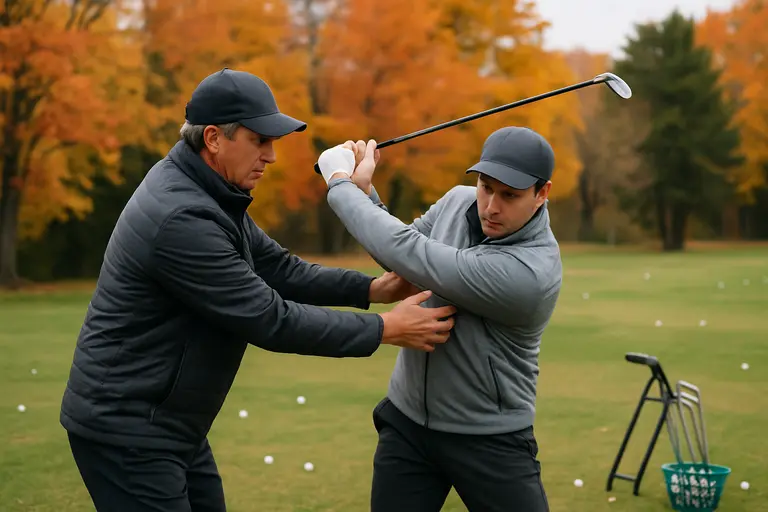
A fitter should want your autumn notes, but those notes need structure. Bring the club that concerns you, the ball you normally play, and a simple record of where the miss shows up. Heel-side divots, toe strikes, thin wedges, and loss of face control all point in different directions. The answer might be lie angle, length, grip size, swing delivery, or no equipment change at all.
This is where launch-monitor data helps beginners and improving players avoid guesswork. Carry distance, launch, spin, peak height, descent angle, and side dispersion all help separate feel from performance. A wet, cool round may make shots seem short. A launch-monitor session can show whether ball speed and carry are truly down, or whether the course simply is not giving summer rollout.
Keep Seasonal Records Simple
You do not need a complicated spreadsheet. A short note after a round is enough: course condition, surface type, clubs that behaved well, clubs that did not, and whether the strike pattern matched the result. If you keep seasonal golf resources and local service contacts organized, a related site in the same network, Efficient Directory, can sit alongside your usual pro-shop and fitter notes.
The goal is to give your next fitting or repair visit better evidence. A club that struggles only in soft turf may need a different conversation than a club that misses the same way indoors, outdoors, from mats, and from grass. Autumn can reveal those differences because the ground changes faster than the golfer’s habits.
Fall Club Maintenance For Smarter Autumn Rounds
Good fall club maintenance is not about panic changes. It is about keeping the equipment clean enough, dry enough, and documented enough that you can read performance clearly. Courses are protecting turf through aeration choices, overseeding schedules, traffic controls, and practice-tee adjustments. Players should respond by checking contact, caring for grips and grooves, and using launch-monitor data with the surface clearly in mind.
If the club performs well across different lies and the numbers stay inside your normal pattern, trust it. If the same miss keeps showing up across surfaces, bring that evidence to a qualified fitter or repair shop. Autumn is a strong season for learning what your set does under less-than-perfect conditions, and that knowledge is often more useful than a quick equipment change.