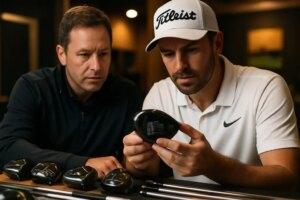
Hybrid clubs are not gone, but their place in elite men’s golf has changed. As a fitter, I see this less as a trend to copy and more as a reminder to test the long end of the bag with launch, spin, descent angle, strike pattern, and real course use in mind. A tour player’s replacement for a 3-iron is not automatically the right answer for a 12-handicap who needs help carrying a front bunker or holding a firm par-5 green.
The recent shift has been clear at the top of the men’s game. Golf Monthly reported that, during the 2025 PGA Tour season, only 20% of the top 50 players in the FedEx Cup standings carried hybrid clubs, based on the bags it reviewed for that group Golf Monthly’s tour-bag review. That does not make the club type obsolete. It means higher-speed players are finding other shapes that match their launch windows, preferred turf interaction, and shot bias.
Why Hybrid Clubs Are Losing Tour Share
Why Tour Bags Are Changing
At tour speed, a long-game club has to do more than fly a certain number. It needs to start on the intended line, fit a predictable curvature pattern, cover a precise carry gap, and land at an angle that makes sense for the target. Many elite players now prefer high-lofted fairway woods or utility irons because those heads can create a clearer fit for a specific job.
One reason is center of gravity. The research supplied for this topic notes that hybrids with a more forward center of gravity can become more volatile for high-speed swingers. In fitting terms, that may show up as a left miss for a player who releases the club hard, or as launch and spin that move too much from strike to strike. A tour player may have enough speed to launch a utility iron properly, or enough delivery control to use a 5-wood or 7-wood without fearing excess curve.
That does not mean hybrid clubs are poor tools. It means the head shape needs to match the delivery. A golfer with a shallow attack, moderate speed, and a need for carry height may see the opposite result from a tour player. For that golfer, a hybrid can still be the easiest club to launch from the fairway and light rough.
Where Hybrid Clubs Still Fit
The LPGA reference in the research is a useful fitting clue: hybrid clubs remain more common where swing speeds are closer to many recreational players. That matters. A player who does not create tour-level ball speed may need help launching the ball high enough, especially from uneven lies or into elevated greens. A club that looks unfashionable in one group can still be the best scoring tool for another.
In the shop, I do not start by asking whether a player wants to follow a tour trend. I start with the miss. Does the golfer thin long irons? Does the ball fall out of the air with low spin? Does the player fear the hybrid hook? Does the fairway wood look too large behind the ball? Those answers narrow the test before the launch monitor even starts collecting numbers.
What Woods And Utility Irons Change In Ball Flight
High-Lofted Fairway Wood Shape
Modern 5-woods, 7-woods, 9-woods, and even higher-lofted fairway woods give fitters a different way to create height. The research notes that these clubs tend to launch higher, spin more, and land softer than a hybrid with the same stated loft. That can be useful on firm greens, long par 3s, or second shots where the ball has to carry a hazard and stop quickly.
Head size also changes confidence. Some golfers like seeing more mass behind the ball. Others feel the opposite and prefer a compact head. The right answer is not only a launch-monitor number; it is whether the golfer can aim it, commit to it, and repeat the strike on the course. A 7-wood that produces the best indoor carry number but scares the player from a tight fairway is not a finished fit.
Utility Iron Profile
Utility irons sit on the other side of the decision. They keep a more iron-like look while adding stability compared with a traditional long iron. Golf.com has described utility irons as part of the long-iron replacement conversation at the professional level, alongside fairway woods and hybrids Golf.com’s long-iron options. For a faster player who wants a flatter flight, lower spin, and a club that can be used from the tee, the utility iron can make sense.
The trade-off is launch. Many recreational golfers like the look of a utility iron, but the ball may not climb high enough to create useful carry or stopping power. If the shot lands too flat and runs through the target area, the fitting has missed the course requirement. That is why I prefer to compare peak height and descent angle, not only total distance.
Fitting Decisions For Long-Game Gapping
Build A Test Matrix
A useful long-game fitting should compare clubs by job, not by label. The test might include a 5-wood, 7-wood, hybrid, and utility iron around the same distance slot. The fitter should watch strike location, launch, spin, peak height, carry distance, descent angle, left-right dispersion, and the player’s comfort with the head shape.
- Need height and soft landing: test a higher-lofted fairway wood first.
- Need iron-like aim and a tee option: test a utility iron with enough loft to launch.
- Need easy carry from mixed lies: keep a hybrid in the test rather than removing it too early.
- Need tighter gapping: adjust loft, shaft length, and shaft weight before changing club category.
Loft alone can mislead. A 21-degree fairway wood, 21-degree hybrid, and 21-degree utility iron can produce very different flights because of shaft length, head size, center of gravity, face design, and strike tendency. If you are comparing options, it also helps to understand how fitting value is measured against the total build, not just the head choice; our related note on custom fitting and premium golf club pricing covers that broader buying decision.
Read The Strike Pattern
Launch-monitor data should be paired with face contact. A golfer who strikes a fairway wood low on the face may see low spin and weak launch, even if that category should theoretically fly higher. A player who hits a utility iron toward the toe may lose ball speed and direction. A hybrid struck center-face may beat both, even if tour usage points another way.
On-course performance has to be part of the final call. A fitting bay can identify the best candidates, but the golf course reveals lie tolerance, visual comfort, and decision-making under pressure. If the club is mainly used from the tee on short par 4s, a utility iron might earn the spot. If it is used for long approaches into greens, a higher-lofted wood may be better. If it has to work from fairway, rough, and uneven lies, the hybrid still has a strong case.
For readers interested in broader sports and community stories, our network includes sites like AP Levante that provide additional coverage. Here, the equipment point stays simple: the bag should be built from your shots, not from someone else’s trend line.
Choosing Between Hybrid Clubs, Woods, And Utility Irons
The smarter response to the tour shift is not to remove a club category from consideration. It is to test each option against the shot you actually need. If your long-game miss is low launch, low spin, and poor stopping power, a 7-wood or 9-wood may be worth serious testing. If your miss is too much curve with a wood-shaped head, a utility iron may control start line better. If your main need is reliable launch from varied lies, a hybrid may still be the cleanest fit.
My fitting advice is to bring your current longest iron, current fairway wood, and the club you trust most from 170 to 220 yards, depending on your speed. Those reference points show whether the new club fills a real gap or only duplicates a distance you already cover. Look for playable carry gaps, predictable misses, and a flight that matches your course conditions.
The decline at the top of men’s professional golf is real, but it is not a verdict on every golfer’s bag. High-lofted fairway woods and utility irons have earned attention because they solve specific launch and control problems for certain players. The right long-game club is the one that gives you a repeatable shot pattern, sensible spacing, and enough confidence to use it when the score matters.