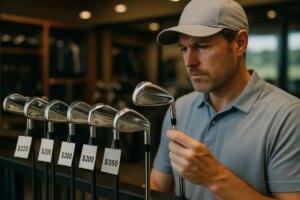
Golf Gadgets 2026 are most useful when they help a golfer answer fitting questions, not when they simply produce more numbers. A launch monitor, rangefinder, GPS watch, shot-tracking system, wrist sensor, or putting aid should connect practice to better club selection, cleaner gapping, and smarter scoring choices. None of that guarantees lower scores, but it can give a fitter and player a clearer picture than range feel alone.
The right tool depends on the job. A player chasing driver efficiency needs different feedback than a golfer trying to stop guessing between a 7-iron and 8-iron. A new wedge setup needs turf, spin, and carry checks. A putting practice mat may be more useful than a premium radar unit if three-putts are the real leak. That is the fitter’s view: buy data only if you know how you plan to use it.
For readers interested in exploring related gear discussions within our network, Back2Tap offers insights to compare, although our emphasis remains on evaluating fitting value: what each device can reveal, its limitations, and how to incorporate those insights into a more effective equipment session.
Golf Gadgets 2026 And The Fitting Bay
In a fitting bay, data has to earn trust. Club speed, ball speed, launch, spin, carry, descent angle, face delivery, and dispersion can all influence a recommendation, but only if the data is gathered in a repeatable way. That is why the best tools are not always the most expensive ones. The best tool is the one that answers the question in front of you.
Why Golf Gadgets 2026 Need A Baseline
Before testing any new driver, iron shaft, wedge grind, or golf ball, build a baseline. Hit shots with the club you actually play, not the club you wish you played. Record the normal miss. Note carry distance, not just total distance. Total distance can change with turf, wind, and rollout. Carry distance is usually the cleaner fitting number.
This is where Golf Gadgets 2026 can help. A launch monitor can show whether an iron is falling out of the air with too little spin, whether a driver is spinning too much, or whether a hybrid and long iron overlap. Shot-tracking sensors can show whether the club you trust on the range is costing strokes on the course. A rangefinder can confirm that the yardage book and the golfer’s eye are not telling two different stories.
What A Fitter Looks For First
As a club-fitter, I look for patterns before I look for perfect swings. One heel strike does not mean a driver is wrong. Ten heel strikes with the same build might. One high-spin wedge shot may be a contact issue. A full session of high-launch, low-spin iron shots may point toward shaft, loft, strike, or delivery. The gadget is there to expose the pattern, not to replace the fitting conversation.
If you plan to book a session, bring your own clubs, your gamer golf ball, and any on-course data you have collected. Booking access has also become easier in some parts of the market, with online fitting reservations covered in our note on premium club fitting access. The better prepared you are, the more useful the numbers become.
Launch Monitors Worth Understanding
Launch monitors are the center of many fitting sessions because they connect swing delivery to ball flight. The 2026 market includes compact personal units, high-end simulator units, and tour-level systems. The gap between them is not only price or screen quality. It is what they measure, how they measure it, and how much confidence a fitter can place in the output.
Rapsodo MLM2PRO For Home Practice Feedback
The Rapsodo MLM2PRO sits in the personal launch monitor lane and is notable because the research lists dual optical cameras plus Doppler radar. It captures 13 metrics, including true spin rate and spin axis, and includes 240-fps Impact Vision video, according to Golf Influence testing. For a player practicing away from a fitting studio, those video and spin references can be useful when checking contact quality and start-line tendencies.
The fitting caution is simple: do not treat one range session as final. If the MLM2PRO shows that a 6-iron and 7-iron carry too close together, confirm it across several sessions and, if possible, indoors and outdoors. That gapping note is valuable, but it becomes stronger when it repeats.
Garmin, TrackMan, And Premium Data Expectations
The Garmin Approach R50 is positioned in the research as a high-end all-in-one option in 2026, with three high-speed camera sensors and indoor simulator use. For a golfer building a home practice space, that kind of unit is not only about seeing ball flight. It can create a structured place to test carry windows, club selection, and shot shape without waiting for perfect range weather.
TrackMan 4 remains in the premium category in 2026 evaluations, and Golf Monthly’s launch monitor testing places it among the best devices tested for the year while noting the broader launch monitor field across different budgets and use cases through its launch monitor reviews. In fitting rooms and on tour ranges, premium systems are valued because they help separate strike, delivery, and ball flight with a high level of detail. That does not mean every golfer needs one at home. It means a serious fitting should produce numbers that can stand up to repeated swings.
On-Course Tech For Smarter Decisions
Not every useful gadget belongs behind a hitting mat. Some of the best information comes during actual rounds, where lies change, wind matters, and pressure changes decision-making. Rangefinders, GPS watches, and shot-tracking systems can show whether a golfer is picking the right target, carrying trouble, or chasing flags that do not fit their dispersion.
Rangefinders And GPS Devices
The research notes several rangefinder and GPS categories for 2026. The Bushnell A1-Slope is described as an ultra-compact laser with slope adjustment, target-lock vibration, and a built-in magnet for cart attachment. The Bushnell Pro XE is listed with 7x magnification, Visual JOLT feedback when the flag is locked, and an Elements feature that factors wind speed and elevation into a plays-like yardage.
Those features can be helpful, but the fitting value is more specific: they teach distance discipline. If a player constantly thinks a back flag is 148 yards but the rangefinder says the safe carry is 137 with trouble long, the club choice changes. In a fitting, that player may not need stronger lofts. They may need clearer carry gaps and better target selection.
The Garmin Approach S12 GPS watch is identified in the research as a value-oriented golf watch that syncs with the Garmin Golf app, tracks distances, maps holes, and has a strongly rated battery. A GPS watch is less exact than a laser to the pin, but front-middle-back yardages can be more useful for scoring. Many mid-handicap players would save stress by playing to the middle number more often.
Shot Tracking And Club Decisions
Arccos Smart Sensors Gen 4 are described in the research as 14 ultra-lightweight sensors that screw into club grips, log shots during real rounds, and use an AI virtual caddie for club suggestions based on shot history and wind. That kind of round-level data can be very valuable before a fitting because it moves the conversation from memory to evidence.
A golfer may believe the 3-wood is a reliable fairway finder. Shot tracking might show that it rarely advances the ball enough to justify the risk. Another player may think the pitching wedge carries 125 yards because of one perfect strike, while the on-course pattern says the stock number is shorter. Those findings can influence fairway wood setup, hybrid spacing, wedge gapping, and even whether an iron set should bend weaker or stronger.
Training Sensors And Practice Aids
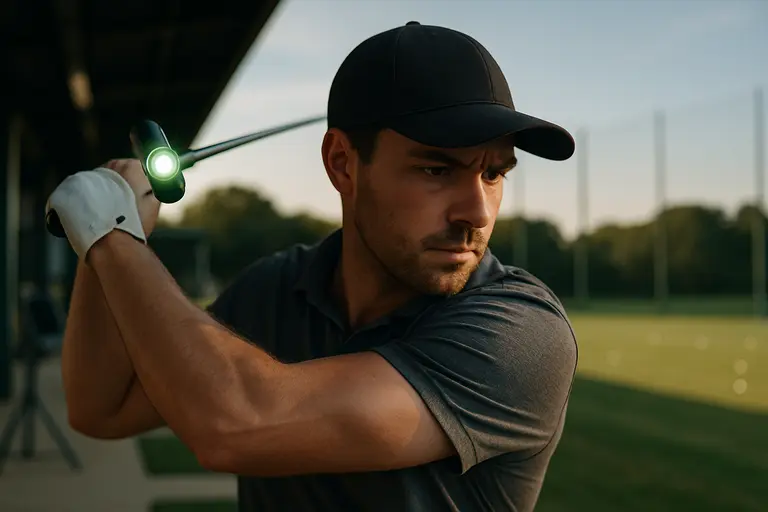
Golf Gadgets 2026 are not only about full shots. Swing sensors and putting aids can be useful when they isolate one controllable variable. The key is to avoid chasing every metric at once. A player who changes wrist condition, face angle, ball position, and tempo in the same session will not know which change mattered.
Wrist, Face, And Impact Feedback
HackMotion Core is described in the research as a 3D wrist sensor that tracks lead wrist flexion and extension plus radial and ulnar deviation at 200 samples per second. The app gives audio cues when wrist position crosses set thresholds, such as cupping or bowing. For some golfers, that is useful because wrist condition can influence face control. For others, it can become noise unless paired with a coach or fitter who understands the player’s ball flight.
Uneekor AIMY is listed as a newer photometric or optical feedback device available in 2026, using infrared cameras to detect path errors, face angles, and impact location during the swing. That kind of feedback fits indoor and simulator practice, especially when a golfer is trying to connect strike location with launch monitor output.
Putting Tools With Practical Value
Putting mirrors, pressure mats, and alignment aids remain easy to overlook because they do not feel as advanced as radar or camera systems. Still, they can be highly practical. Setup consistency, face aim, start line, and stroke length are scoring skills. A player who practices ten-foot putts with a mirror and a consistent gate may learn more than a player hitting driver for an hour without a plan.
For a fitter, putting data can also affect equipment. If the golfer consistently aims left with one head shape and closer to target with another, putter style matters. If distance control breaks down on longer putts, weight, length, grip, or head balance may deserve a test. The practice tool does not fit the putter by itself, but it can expose the issue.
Best Uses For Golf Gadgets 2026
The best way to sort these tools is by fitting question. If you need carry gaps, start with a launch monitor. If you need on-course truth, start with shot tracking. If you need target clarity, start with a rangefinder or GPS watch. If you need face and wrist control, use a sensor carefully and keep the goal narrow.
| Tool Type | Best Fitting Use | Watch-Out |
|---|---|---|
| Launch Monitor | Carry gaps, spin, launch, dispersion | One session can mislead if strike quality is poor |
| Rangefinder | Pin distance and plays-like yardage | Pin hunting can hide smarter middle-green choices |
| GPS Watch | Front, middle, back strategy | Less exact than laser-to-flag yardage |
| Shot Tracking | Real-round club performance | Needs enough rounds to show patterns |
| Practice Aid | Setup, face aim, stroke or wrist feedback | Too many swing thoughts can stall progress |
Use this short process before buying or testing any device:
- Pick one question. Examples: driver spin, wedge gaps, 3-wood usefulness, or putting start line.
- Measure the current club first. A baseline keeps the new gadget from becoming a toy.
- Repeat the test. Good fitting patterns survive more than one session.
- Bring the data to a fitter. Numbers are strongest when paired with ball flight, strike, and build specs.
Golf Gadgets 2026 can make practice more productive, but they work best as decision tools. The player still has to hit the shot, choose the target, and commit to the club. The technology is there to make those choices clearer, not to promise a scorecard change.