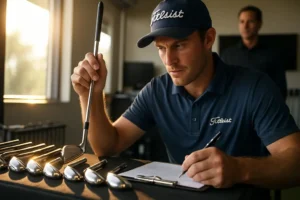
The best budget irons 2026 conversation should start in the fitting bay, not on a product page. Price matters, but the right set is the one that protects your weak strikes, gives you usable carry gaps, and lets you aim with a shot pattern you can trust. A lower-cost iron can be a smart buy; it can also become expensive if the shaft, lie angle, loft structure, or set makeup misses your needs.
That is the lens I use as a club-fitter. A value iron is not automatically a beginner iron, and a direct-to-consumer head is not automatically a bargain for every golfer. The build has to match your delivery. The launch monitor has to show more than one pretty 7-iron. The set has to make sense from the longest iron you can launch to the wedge end where scoring gaps get tight.
How Budget Irons 2026 Should Be Fit
Treat budget irons 2026 as a fitting project with a spending limit, not as a hunt for the cheapest box of clubs. The useful question is simple: what problem must the iron solve? Some golfers need launch and forgiveness. Others need tighter left-right dispersion. Some need a lighter shaft to keep speed through the set. Others need a heavier build to calm timing.
Budget Irons 2026 Data To Bring Into A Fitting
A good iron test should capture median carry, front-to-back distance spread, launch, peak height, descent angle, start line, and curvature. Median carry tells you the number you can play from, not the one flushed shot you remember. Distance spread shows whether the club creates playable misses or random yardages. Launch, peak height, and descent angle help explain whether shots can stop on the green. Start line and curvature show whether the head and shaft are helping you control face delivery.
Do not test only a 7-iron if you can avoid it. The long end shows whether the head has enough help to launch. The short end shows whether the set creates scoring gaps you can use. A golfer may hit a 7-iron well in a fitting and still struggle if the 5-iron flies too low or the pitching wedge goes too far from the next wedge.
Why Category Comes Before Brand
Iron categories are not perfect, but they help narrow the test. Players irons suit strong ball-strikers who value compact shaping and flight control. Players-distance irons add speed help while keeping a slimmer look. Game-improvement irons usually add more forgiveness, launch support, and offset. Super-game-improvement irons are built for golfers who need the most help on mishits and launch.
Brand names should come after that category decision. If your strike pattern is low on the face and toward the toe, a compact head that looks great in the bag may not help you score. If your common miss is a pull hook, a highly offset iron may need careful testing before it earns a spot. The fitting job is to match the club’s help to your actual miss, not your favorite photo.
Value Models With Real 2026 Test Support
Independent testing gave value shoppers useful signals in 2026. MyGolfSpy tested 47 irons and reported on July 30, 2026, that the Takomo 101 MKII stood out in its value testing, including strong accuracy, distance, forgiveness, and the lowest price in its tested field, according to the MyGolfSpy iron test. That does not mean it fits every golfer, but it does make the head worth testing if the category matches your swing.
GolfMagic also highlighted the Takomo 101 MKII in its July 10, 2026 budget iron coverage, listing a 5-GW set RRP around £529 and noting design points such as a variable thickness face, progressive weighting, and KBS shaft options in its budget golf irons picks. Those details matter only after the fitter checks launch, spin, strike, and set flow.
| Model Mentioned In 2026 Research | Why It Matters In A Fitting | What To Verify |
|---|---|---|
| Takomo 101 MKII | Strong value-test support and broad game-improvement appeal | Shaft weight, launch window, gapping from 5-iron through gap wedge |
| Tour Edge Hot Launch Max D | Reported as strong in super-game-improvement accuracy and forgiveness testing | Offset comfort, left-right pattern, peak height |
| Budget cavity-back sets | Often target forgiveness and whole-set value | Feel, build tolerance, grip size, lie angle, wedge transition |
For most golfers, budget irons 2026 should include at least one game-improvement option and one super-game-improvement option if launch or strike consistency is a concern. That comparison tells you whether extra head size and offset help your scoring pattern or simply change the miss. A wider sole can be helpful for some turf interactions, but it can feel clumsy to a player who already delivers shallow contact. Testing decides it.
Where Budget Iron Savings Can Disappear
The purchase price is only one part of value. A low-cost iron that needs new shafts, different grips, loft and lie work, or a rebuilt wedge setup may no longer be the best buy. That is especially relevant with direct-to-consumer clubs, where demo access can be limited compared with larger retail fitting carts.
Shaft And Grip Fit Are Not Afterthoughts
Shaft flex gets most of the attention, but weight is often the first check. A shaft that is too light can make face control noisy for one golfer and free up speed for another. A shaft that is too heavy can improve rhythm for one player and drain speed for another. The correct answer shows up in strike pattern, start line, speed retention, and repeatability.
Grip size can change face behavior and comfort. A grip that is too small may encourage excess hand action for some players. A grip that is too large may reduce release for others. Those are tendencies, not laws, so they need to be tested with the player’s normal motion.
Loft Gaps Need A Course Test Mindset
Modern iron sets can create strong lofts and long numbers, but the scorecard does not care how far a 7-iron goes if the next clubs bunch together. In a fitting, I want to see whether each club has a job. If a 6-iron and 5-iron fly nearly the same distance, the golfer may need a hybrid, high-launch iron, or different set makeup. If the pitching wedge is much stronger than the specialty wedges, the golfer may need a gap wedge plan before ordering.
This is where launch monitor work connects to scoring. A golfer who knows the ball carries 142 yards with a normal 8-iron and usually misses within a playable window can make clearer decisions than a golfer chasing the longest single shot. For more on how fitting data links to dispersion and on-course choices, FS Golf has covered club fitting performance lessons through recent iron-test thinking.
Buying Process For A Smarter Budget Set

A smart purchase starts with a short list, but it should end with measured proof. Bring your current 6-iron, 7-iron, pitching wedge, and any gap wedge to the fitting if possible. That gives the fitter a baseline for speed, carry, height, and gapping. It also shows whether your current issue is the head, shaft, lie angle, set makeup, or delivery.
- Test at least two iron categories if your handicap or strike pattern sits between profiles.
- Compare good strikes and common misses, not only the longest ball.
- Check lie angle with ball flight and strike location, not a static chart alone.
- Confirm the wedge end before ordering a 5-GW or 6-PW set.
- Ask what changes would cost later if shafts, grips, or lofts need adjustment.
Budget buying also benefits from the same discipline used in other equipment categories: match the tool to the job, then compare total ownership cost. For readers interested in practical equipment-first mindsets across different sports, Triple T Powersports provides similar insights within the motorsports arena.
Choosing The Right Set Of Budget Irons 2026
The right budget irons 2026 set is the one that gives you repeatable yardages, enough launch, and a dispersion pattern you can play. The Takomo 101 MKII has earned attention from 2026 value testing and buyer coverage, while models such as the Tour Edge Hot Launch Max D show that higher-forgiveness categories can still be part of an accuracy discussion. Those are starting points, not automatic answers.
Go into the fitting with a clear miss pattern and a firm budget. Let the fitter test category, shaft, lie, and set makeup before brand loyalty takes over. If a lower-priced head gives you playable numbers without expensive rebuild work, that is real value. If it needs major changes to become playable, the better deal may be a different model, a different shaft, or a smaller set built around clubs you can actually launch and gap.