The Exotics Milled Wedge line gives fitters a clear loft-and-bounce story to work from: three bounce profiles, lofts spanning 50° to 60°, and 17 total loft/bounce combinations. Tour Edge announced the series on September 1, 2026, with retail availability beginning September 14, 2026, according to the company’s official launch release. For golfers, the useful question is not whether one grind is “best.” It is which sole, loft, and bounce combination matches delivery, turf, bunker conditions, and the rest of the set.
Wedges are where small fitting mistakes show up fast. A player can tolerate a driver that is a little imperfect and still hit playable shots. A wedge with the wrong bounce can make a simple pitch feel like guesswork. Too little bounce for a steep player can encourage digging. Too much bounce for a shallow player on firm turf can raise the leading edge and make contact harder to manage. That is why this line is best read as a fitting matrix, not just a product sheet.
Exotics Milled Wedge Loft And Bounce Matrix
How The Exotics Milled Wedge Profiles Split
The three profiles are Low Bounce, Mid Bounce, and High Bounce. The Low Bounce profile sits in the 6° to 8° range and is aimed at firmer turf, tighter lies, and sweeping attack patterns. The Mid Bounce profile is listed around 10° and is the broadest starting point for neutral deliveries and mixed course conditions. The High Bounce profile moves into the 12° to 14° range and is built for softer turf, sand, and steeper swings.
The Exotics Milled Wedge matrix matters because not every bounce profile is offered at every loft or hand. Mid Bounce is the central profile and is offered from 50° through 60°. The right-handed Low Bounce and High Bounce options begin at the higher lofts: 54°, 56°, 58°, and 60°. Left-handed golfers have a narrower path, with Mid Bounce options in 52°, 56°, and 60°.
Why The 50° To 60° Range Matters
A 50° wedge often acts as a gap wedge for players whose pitching wedge has moved stronger in loft. The 54° and 56° range often handles fuller sand-wedge swings and many basic pitch shots. The 58° and 60° lofts are where higher-launch short-game shots, bunker options, and open-face shots become more common. Those roles are not fixed for every player, but they give a fitter a practical map.
The key is to avoid choosing lofts by habit alone. A player who says, “I have always played 52°, 56°, 60°,” may still need that setup, but the fitter should confirm carry gaps, partial-shot control, strike location, and turf interaction. If the pitching wedge is strong, a 50° gap wedge may make more sense. If the player rarely opens the face and plays on soft courses, a higher-bounce 56° or 58° can be more useful than a low-bounce lob wedge that looks good in the bag but struggles through the ground.
How Bounce Profiles Change The Fitting Conversation
Low Bounce For Shallow Delivery And Firm Ground
Low Bounce can be valuable for golfers who sweep the ball, play firm turf, or need the leading edge to sit closer to the ground on tight lies. It is not automatically the “skilled player” option. A low-bounce wedge can punish a steep move, especially when the ground is soft. In a fitting, I want to see how the club exits the turf, not just how the sole looks at address.
For a shallow player, the Low Bounce version can help produce cleaner nips on short pitches and open-face shots from firm lies. The fitter still needs to test strike and launch. If the ball starts too low, contact moves up the face, or the player begins adding handle lean to avoid the sole, the loft/bounce choice may be creating extra work.
Mid Bounce As The Baseline Test Head
Mid Bounce is the safest place to start many fittings because it gives enough sole to protect imperfect strikes without pushing the leading edge too high for average turf. Since it is offered across the widest loft range, it also works well for building a full wedge set with consistent feel and predictable turf response.
This is especially relevant for left-handed players in this line. Because the left-hand options are Mid Bounce only in 52°, 56°, and 60°, the fitting conversation becomes more specific: does that profile work well enough across the player’s full-shot, pitch-shot, and bunker needs? If the answer is yes, the set can be straightforward. If the player needs a very low or very high bounce lob wedge in left hand, this particular line may not cover that need.
High Bounce For Steeper Swings And Softer Lies
High Bounce is where the sole starts doing more of the work for steep swings and soft conditions. Golf Digest reported that the high-bounce versions are built around 12° to 14° bounce and noted the soft 304 stainless steel construction with a triple-chrome plated satin finish in its Tour Edge wedge report. In fitting terms, that higher bounce range can help the sole resist digging when the club enters the turf or sand with more angle.
The trade-off is lie sensitivity. A high-bounce lob wedge can be excellent in fluffy sand or soft turf, but it may feel harder to slide under the ball from a tight, firm lie if the player does not manage face angle and shaft lean. That is why a launch monitor is useful, but it cannot replace hitting shots from real turf and sand whenever possible.
Sole, Face, And Material Details
TriGrind Sole Design In Practice
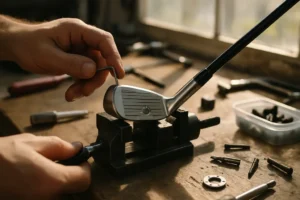
The sole uses what Tour Edge calls a TriGrind construction: a chamfered leading edge, a flatter center section with reduced camber, and trailing-edge relief. In plain fitting language, those three areas influence how the club enters, rides through, and exits the turf. The chamfered leading edge is intended to reduce digging. The flatter center section is meant to support cleaner contact. The trailing-edge relief helps when the face is opened around the greens.
That design does not remove the need for bounce fitting. Relief can make a wedge more playable, but delivery still rules the fit. A player with a steep angle of attack can still dig with too little bounce. A player who sweeps the ball can still catch thin shots if the sole sits too high for the lie. The Exotics Milled Wedge should be tested with the player’s normal short-game motions, not just full swings from a mat.
Milling, Grooves, And Wet-Condition Questions
The heads are CNC-milled and use Tour Edge’s SuperSpin grooves, described in the research notes as having steeper wall geometry, tighter spacing, and face texture. Those features are aimed at spin production from varied lies and damp conditions. Fitters should still be careful with promises. Groove design can support spin, but strike quality, ball model, moisture, grass type, and delivery all affect the number.
For readers interested in learning more about manufacturing processes related to modern club production, CAD/CAM machining coverage offers insights into computer-controlled cutting and design techniques. In wedge fitting, the practical takeaway is simple: precise face and sole shaping gives the fitter more defined options, but the golfer’s delivery decides which option works.
Building A Wedge Set Around Yardage Gaps

Start With The Pitching Wedge
The first fitting checkpoint is not the lob wedge. It is the pitching wedge. A modern iron set may leave a large gap between pitching wedge and the first specialty wedge, and that can force a player into half-swings too often. The loft range in this series starts at 50°, which can fit the gap-wedge slot for many players, but the right answer depends on measured carry distance and the player’s preferred short-game shots.
Good wedge gapping is not only a loft chart. I want to see full carry distance, three-quarter carry distance, launch, spin, descent, and strike pattern. If two wedges fly too close together, one slot is wasted. If the gap is too large, the player may need to manufacture distance on too many approach shots. That is where the Exotics Milled Wedge loft range gives a fitter room to test, especially through the common 50° to 60° spread.
- Check carry gaps first: confirm the distance from pitching wedge into the first specialty wedge.
- Test turf interaction: hit shots from fairway-height grass, rough, and sand if possible.
- Match bounce to delivery: compare divot depth, entry point, and strike pattern rather than choosing by handicap.
- Keep the scoring shots in view: full swings matter, but so do 30-, 50-, and 70-yard shots.
Players comparing other high-loft wedge formats may also find value in our fitting-first look at Callaway Full Toe SP wedges, especially if they are deciding between a traditional face shape and a more specialized short-game head.
Exotics Milled Wedge Build Notes For Fitters
Stock Components And Buying Checks
The stock shaft listed in the research is the KBS Hi-Rev 2.0 at about 115 grams, with a Golf Pride Tour Velvet 360 Black grip. The research notes also list MSRP at US$119.99 per wedge. As with any club purchase, golfers should verify current pricing, shaft options, grip availability, and hand/loft inventory at the time of order because retail details can change after launch.
Fitters should treat the Exotics Milled Wedge line as a clean decision tree: choose the loft gaps first, test Mid Bounce as the baseline, then move into Low Bounce or High Bounce only when the turf and delivery make a clear case. Right-handed players have the widest range of bounce choices in the higher lofts. Left-handed players get fewer configurations, so the fit needs to be confirmed with more care before ordering.
The strongest use case for this series is not a single magic loft. It is the chance to build a set around the shots a player actually hits: a reliable gap wedge, a sand wedge that enters the ground correctly, and a higher-lofted option that matches the player’s face-control skills. If those pieces fit, the golfer gains a more predictable wedge setup. That does not guarantee lower scores, but it can remove one common source of wasted shots: guessing how the sole will behave at impact.