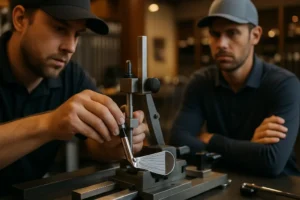
Iron Choices on the PGA Tour in the 2026 regulation season gave club fitters a clear reminder: the best players in the world are not chasing one perfect iron shape from 4-iron through pitching wedge. They are building sets around launch, spin, strike pattern, turf contact, and the shots each part of the bag must produce under pressure.
That matters for club golfers because Tour bags can be useful examples, but poor templates. A plus-handicap player, a 12-handicap player, and a newer golfer may all need very different heads, shafts, loft gaps, and set makeup. Copying a Tour player’s short irons while ignoring your own long-iron launch window is usually a bad trade.
The 2026 PGA Tour regulation season ended in August 2026, and the research notes for this piece tracked 34 tournaments, 38 different winning iron models, and 10 manufacturers represented by winners. The Titleist T100 was the most common winning model in that data set, with nine victories. That does not mean the T100 is the right head for every golfer, but it does show how often compact, precise players irons still fit elite approach players when the delivery pattern supports them. For more on that model’s Tour presence, our related breakdown of Titleist T100 irons looks at what golfers should and should not take from that trend.
What Tour Iron Choices Really Show
The Winning Model Is Only Part Of The Story
The headline model in a winner’s bag rarely tells the full fitting story. A player may list one iron family, but the actual set can include a utility iron, a cavity-back 4-iron, a different 5-iron, bent lofts, altered lie angles, and shafts chosen to control peak height or spin. The head stamping is visible. The build recipe is not always obvious.
For fitters, the better lesson is variety. The research notes showed 38 winning iron models in one PGA Tour regulation season. That range supports what we see in fitting bays every week: golfers can score with different head shapes when the build matches the strike and delivery. A compact cavity can be excellent for one player and punishing for another. A hollow long iron can be a scoring tool for one golfer and a left-miss problem for the next.
| Tour Signal | Fitting Read |
|---|---|
| Many winning models appeared in 2026 | There is no single best iron head for every delivery pattern |
| Titleist T100 led the winning model count in the research notes | Compact players irons still work when strike location and speed are consistent |
| Combo sets remain common among elite players | Long irons and scoring irons can have different jobs in the same bag |
| Blade long irons are rare on Tour | Even strong ball-strikers often want help launching the longest irons |
Iron Choices Start With The Long End
Iron Choices often go wrong at the top of the set. Many golfers pick irons by looking at the 7-iron because that is the fitting bay workhorse. The problem is that a 7-iron can look playable while the 4-iron and 5-iron are too low-launching, too low-spin, or too tightly gapped.
Tour players have moved away from that mistake. A common pattern is to use more forgiving cavity-back or hollow-body long irons, then shift into more compact scoring irons. GOLF.com reported that top iron players often use that kind of blended construction, with more help in the long irons and more control in the short irons near the scoring end of the set GOLF.com iron trend report.
For average golfers, Iron Choices should be tested from both ends. If you hit a 7-iron well but cannot land a 5-iron high enough to hold a green, the set is not finished. The answer might be a different long-iron head, a hybrid, a higher-lofted fairway wood, a lighter shaft, a softer profile, or a loft structure that spreads carry distances more evenly.
Why Combo Sets Keep Showing Up
Forgiveness Is Not Just For High Handicaps
One of the better Tour equipment lessons from the last few seasons is that forgiveness is not an insult. Elite players still care about strike stability, launch, and descent angle. They just want that help without giving up the look, offset, sole shape, and spin control they prefer.
Chris Gotterup offered a useful example. Golf Digest reported that he replaced a traditional blade 4-iron, the Bridgestone Tour B 220 MB, with a prototype Bridgestone B-Forged 100CB 4-iron, moving to a cavity-back option for more forgiveness at the long end Golf Digest equipment report. That is not a recreational shortcut. It is a scoring choice by a high-level player who wanted a better tool for a specific slot.
The fitting lesson from Tour Iron Choices is simple: long irons need enough ball speed retention and height to be useful from real lies. If a long iron only works from a perfect range mat, it may not deserve a place in the bag. A combo set lets the golfer keep precision in the scoring irons while adding launch support where strike patterns tend to widen.
Scoring Irons Need A Different Test
The short irons should not be judged only by ball speed. With 8-iron through pitching wedge, I want to see distance control, spin consistency, face control, and turf interaction. A very hot short iron can look impressive on a launch monitor, but if it creates jumpers or tight gaps into the wedges, it can make scoring harder.
That is why many better players prefer more compact scoring irons. They are not trying to make a pitching wedge fly as far as possible. They are trying to hit the front number, the back number, and the safe side of the green. A scoring iron has to produce predictable carry windows from full swings, three-quarter swings, and imperfect lies.
How A Fitter Tests The Set Makeup
Launch Monitor Data Must Match The Course Job
A useful iron fitting is not a beauty contest between two 7-irons. I want to see ball speed, launch angle, spin rate, peak height, descent angle, carry distance, dispersion, and strike location. Then I want to connect those numbers to the golf course. Does the 6-iron stop on a firm green? Does the 9-iron spin enough without ballooning? Does the pitching wedge leave room for the gap wedge?
For fitters, the most common warning sign is a set that bunches at the top. A golfer may carry a 5-iron only five yards farther than a 6-iron, then hit a hybrid 18 yards farther than both. That is not a badge of consistency. It is a gapping problem. The better build may remove an iron, weaken or strengthen lofts within reason, or change the head type in one or two slots.
- Test the longest iron you expect to carry. If it cannot launch high enough, compare it against a hybrid or utility iron.
- Check carry gaps, not total distance. Rollout changes with turf, wind, and firmness.
- Hit from turf when possible. Sole width, bounce, and leading-edge shape matter more once the ball is not sitting on a mat.
- Blend by need, not by ego. A cavity-back 5-iron and compact 8-iron can live in the same set for sound reasons.
Shaft And Lie Angle Can Change The Answer
Head design gets the attention, but shaft and lie angle can change the fit. A shaft that is too heavy may lower speed and reduce height in the long irons. A shaft that is too light or soft for a player’s move can widen face control. Lie angle can influence start line and strike location, especially in the scoring irons where direction matters as much as raw carry.
That is why a good fitter does not stop after one good shot. I want patterns. A player who hits one perfect 7-iron and four heel strikes is giving me more useful information than the single best ball. The goal is not to build a set around the miracle strike. The goal is to build around the shot pattern the golfer brings to the course most often.
Price, Model Year, And Real-World Decisions
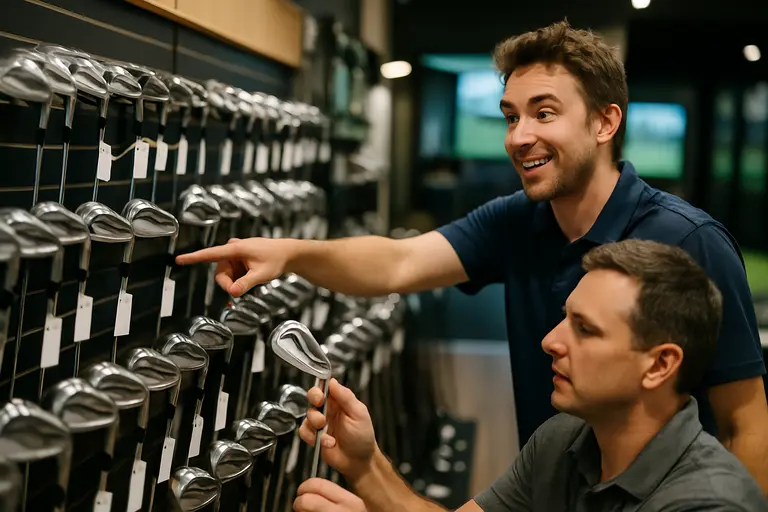
New Does Not Always Mean Better Fit
The research notes also pointed to a practical reality: Tour players are not all using the newest possible iron model in every slot. Many modern designs from the last several model cycles still appear in elite bags. That should reassure golfers who feel pressured to replace irons on a calendar instead of by performance.
Callaway introduced its Quantum iron line in March 2026, with Quantum Max, Quantum Max OS, and Quantum Max Fast models positioned around forgiveness, face-speed consistency, and higher launch. New product families can be worth testing, especially for golfers who need help launching the ball or retaining speed on off-center contact. Still, the correct question is not whether a head is new. The correct question is whether it improves the pattern compared with your gamer and other current options.
Price also needs context. A full iron build can include heads, shafts, grips, loft and lie work, and possible future adjustments. Before ordering, ask exactly what is included, whether gapping is checked after delivery, and whether lie adjustments are part of the service. To explore more sports-related topics, visit AP Levante, our network’s related site that covers broader areas, while here the focus remains on fit, build quality, and scoring use.
Iron Choices That Fit Your Scoring Needs
Copy The Process, Not The Bag
The smart amateur takeaway from Tour equipment is not to copy a winner’s full iron set. Copy the process. Tour players test by role. They ask what the long iron must do from 215 yards, what the 7-iron must do into a tucked pin, and what the pitching wedge must do between wedge gaps. That same logic works for club golfers at different speeds and skill levels.
Iron Choices should help you produce playable height at the long end, reliable distance control in the middle, and predictable spin near the scoring clubs. If a combo set does that, it is worth considering. If a single-model set does it better for your delivery, that is just as valid. The launch monitor should inform the decision, but the course job should approve it.
No fitter can promise lower scores from a head swap alone. Better irons can support better golf only if the build matches your swing, your strike pattern, and your practice habits. The Tour trend is useful because it shows elite players making practical choices, not sentimental ones. That is the standard worth bringing to your own fitting.