The New Titleist Pro V1 and Pro V1x matter because golf ball choice sits at the center of launch, spin, wedge control, and scoring decisions. For newer players, the mistake is thinking of the ball as an afterthought. In a fitting-first view, the ball is part of the system, right beside driver loft, shaft delivery, iron descent angle, wedge gapping, and putting feel.
Titleist introduced its 2025 Pro V1 and Pro V1x models on the PGA Tour in October 2024, 25 years after the original Pro V1 debut in 2000. The design notes in the research point to a high-gradient core, a reformulated high-flex casing layer, a soft cast thermoset urethane cover, and updated aerodynamics. Those are not just catalog terms. They are the pieces that help separate long-game spin from short-game spin, which is the main performance story for most golfers.
That does not mean every player should automatically move into a tour-level urethane ball. It means the ball should be tested with the same discipline as a driver or wedge. If you are building a bag around scoring, the question is not, “What is the best ball?” The better question is, “Which ball produces playable launch, predictable carry, useful spin, and a feel I can repeat under pressure?”
What New Titleist Pro V1 Means For Ball Fitting
New Titleist Pro V1 Launch And Spin Priorities
The New Titleist Pro V1 story starts with separation. In simple terms, a premium ball has to do two things that sound at odds with each other: keep spin controlled on full-speed shots, then produce enough spin and feel on partial wedges. The 2025 Pro V1 and Pro V1x models were designed around lower long-game spin while keeping high spin on scoring clubs and greenside shots.
For a player getting started, that distinction matters more than brand loyalty. Excess driver spin can cost carry and widen misses for some swings. Too little iron or wedge spin can make distance control harder. A good fitter will not judge the ball by one flushed 7-iron. The useful pattern comes from multiple shots: driver, hybrid or long iron, mid-iron, full wedge, half wedge, pitch, and putt.
On the PGA Tour side, early testing had already started in Las Vegas on October 16, 2024, with players comparing the 2025 Pro V1 and Pro V1x for speed and spin windows, according to the PGA Tour equipment report. That type of testing is not reserved for elite players. Recreational golfers can use the same logic, just with fewer variables and a clearer scoring goal.
Pro V1 Versus Pro V1x In Plain Fitting Terms
The Pro V1 and Pro V1x are close relatives, but they are not interchangeable. Based on the research notes, Pro V1 is the softer-feeling, three-piece option with a more penetrating flight, slightly lower launch, and less driver spin. Pro V1x is the firmer-feeling, four-piece option with higher launch and more spin with irons and wedges.
That split gives a fitter a practical starting point. A player who launches the ball too high with too much spin may prefer the flatter flight of Pro V1. A player who needs help holding greens, creating descent angle, or adding iron spin may find Pro V1x easier to score with. The test still has to be player-specific. A slower-speed player, a steep iron player, and a shallow sweeper may all react differently.
This is where launch-monitor work earns its place. Ball speed is useful, but it is not the whole story. With a premium ball test, I would want to see launch angle, spin rate, peak height, descent angle, carry distance, and left-right dispersion. For wedges, I would pay close attention to carry consistency and how much the ball checks on the first bounce.
Why Tour Use Matters, And Where It Can Mislead
Wins Are Evidence, Not A Personal Prescription
Tour use tells us that the product performs at the highest level, but it does not tell us which ball fits your swing. In 2025, Titleist balls accounted for 26 of 46 PGA Tour event wins, with Pro V1 listed for 14 victories and Pro V1x for 12, as reported by GOLF.com’s PGA Tour ball count. That is strong validation of tour acceptance, but tour acceptance is not the same thing as a fitting result for a 14-handicap player, a new golfer, or a senior player trying to manage launch.
The tour player’s ball decision is built on very small windows. They know their launch, spin, yardage, and wedge reaction. They are often choosing between two excellent options, not between good and bad. Amateur golfers need to avoid copying the winner’s golf ball without checking whether it supports their own shot pattern.
For example, if a player already spins wedges enough but struggles with driver carry because of excess spin, Pro V1 may make sense to test first. If another player hits low irons that run through greens, Pro V1x may deserve the first look because of its higher-launch, higher-spin profile. Neither answer is automatic.
Scoring Starts With Predictable Misses
Golfers often talk about distance first, but scoring usually improves through fewer penalty shots, better approach windows, and more predictable wedge carry. A ball that flies three yards longer but produces inconsistent wedge spin may not help a player score. A ball that feels great on chips but balloons into the wind may create a different problem.
The best fitting question is: “What miss can I live with?” If the ball reduces driver spin but causes approach shots to release too much, that is a tradeoff. If it adds height with irons but starts floating in wind, that is also a tradeoff. Good ball fitting identifies the tradeoff before the player finds it during a money match or tournament round.
This is also why ball testing should connect to club fitting rather than sit outside it. Iron loft, shaft delivery, wedge grind, and ball model all influence stopping power. If you want a deeper fitting lens, this FS Golf breakdown on club fitting performance lessons explains why strike pattern, dispersion, and gapping matter more than chasing a single best number.
How To Test Pro V1 And Pro V1x Before Switching
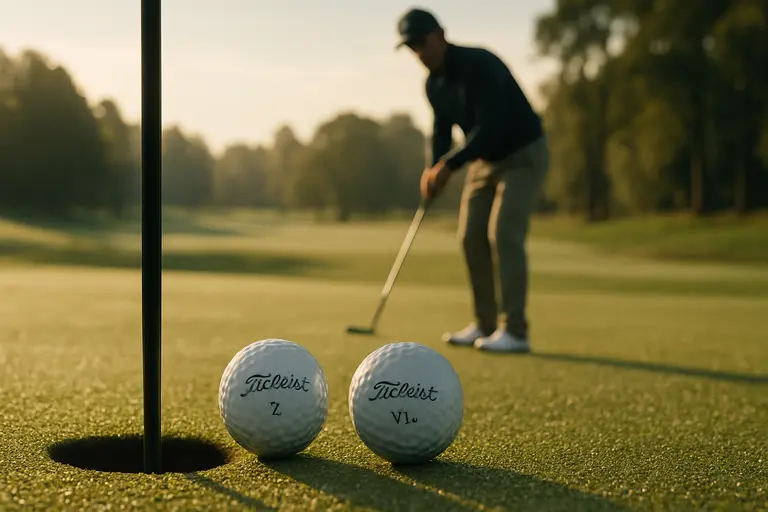
Start With The Scoring Clubs
Many golfers test golf balls backward. They hit driver first, pick the longest one, then accept whatever happens around the green. A better process starts with the shots that decide scores most often: putts, chips, pitches, and wedges. If you dislike the sound or feel off the putter, you may not commit to the ball. If half-wedges launch unpredictably, the long-game benefit may not matter.
Start with 30- to 70-yard wedge shots. Hit enough shots to see carry range, spin response, and strike feedback. Then move to a full wedge and a mid-iron. Only after that should driver enter the test. Driver is important, but it should not erase a poor short-game fit.
- Test the same clean golf ball model for several shots, not one swing per model.
- Use your gamer wedge and iron so the comparison stays fair.
- Track carry distance, launch, spin, peak height, descent angle, and dispersion if a monitor is available.
- Finish on the practice green with chips, pitches, bunker shots, and putts.
If your golf plans also include a group trip or casual outing, consider looking into travel options that complement the golfing experience. Our related network site Bass Lake Roadhouse offers insights into leisure planning that pairs well with recreational golf travel.
Fitting The New Titleist Pro V1 Against Pro V1x
Fitting the New Titleist Pro V1 against Pro V1x should be a comparison of patterns, not isolated highlights. Hit five to ten usable shots with each club and remove obvious mishits only if you remove them for both balls. Watch what the average does, but also watch the bad shot. If one ball keeps the miss in a better window, that can matter more than one extra mile per hour of ball speed.
For players who fight too much curve, do not assume the ball alone fixes dispersion. Face angle, path, strike location, shaft fit, and driver loft still carry major influence. The ball can fine-tune spin and flight; it cannot correct a swing delivery problem by itself. That is why a fitter should use the ball test to support the player’s motion, not hide it.
For newer players, the simplest useful test is a two-ball on-course comparison. Play one ball on odd holes and the other on even holes for several rounds, or play two balls from the same location during quiet practice times if the course allows it. Keep notes on driver flight, approach hold, wedge check, putter feel, and confidence in wind.
New Titleist Pro V1 And Pro V1x Scoring Read
The scoring significance of the New Titleist Pro V1 and Pro V1x is not that they promise a lower handicap by themselves. The significance is that they give golfers two clear fitting paths inside the same premium family: Pro V1 for a softer, more penetrating profile, and Pro V1x for higher launch and more iron-and-wedge spin.
For a beginner or improving player, that clarity is useful. If your shots fly too high and spin too much in the long game, Pro V1 is a logical test. If your irons need more height or your wedges need more stopping power, Pro V1x is a logical test. The right answer should show up in launch-monitor data, wedge control, and how the ball behaves on the course.
Choose the model that gives you repeatable yardages, playable misses, and a short-game response you trust. That is the fitting-first way to judge any golf ball, whether it has tour wins behind it or not.