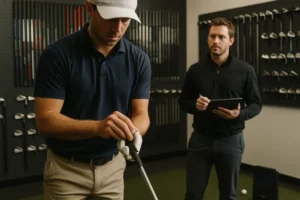
The GTS300 Mini Driver is a build-and-materials story first, not just another long-club release. Titleist introduced the club on July 14, 2026, and the headline design change is a 305cc head that is 25cc larger than the previous GT280, according to the Seoul Economic Daily launch report. For a fitter, that matters because size, center of gravity, face construction, and shaft length all influence how a golfer produces speed, launch, spin, strike pattern, and playable dispersion.
A mini driver sits in a tricky slot. It is not meant to be judged only against a 460cc driver, and it is not a direct fairway wood replacement for every player. The useful question is narrower: does the club create a better tee option, a playable second-shot option, or both? That answer depends on attack angle, strike height, face contact, launch window, and the golfer’s confidence looking down at the head.
Why The GTS300 Mini Driver Starts With Head Size
Stability From A Larger Footprint
The 305cc head gives Titleist more room to position mass than it had in the smaller GT280. That does not mean every golfer will hit it straighter. It means the head design gives the fitting process a wider starting point for stability testing, especially for players who miss across the face rather than in one small, repeatable spot.
The research notes report that the larger head, composite crown, deeper center of gravity, and moment-of-inertia improvement of 15 to 20 percent are key design aims. In fitting language, that points toward a head intended to resist twisting better on off-center contact. The player still has to deliver the club, but a more stable head can help preserve launch and ball speed when impact moves slightly away from center.
Why 305cc Is Not Just A Smaller Driver
A 305cc head changes the visual and delivery equation. Some golfers see a smaller head and make a freer swing. Others lose confidence because the hitting area looks less forgiving than a full-size driver. That is why I do not fit this category from specs alone. I want to see whether the golfer’s strike tightens, whether tee height becomes more consistent, and whether the ball flight holds up under a normal on-course swing.
Head size also affects how a club works from the turf. A larger mini-driver head can provide tee-shot confidence, but turf use still depends on face height, sole interaction, launch, and the golfer’s low-point control. If the ball is struck thin or low on the face, the head’s face design becomes a major part of the evaluation.
Face, Crown, And Aerodynamics In The Build
Forged L-Cup Face And Low-Face Contact
Titleist describes the club with a forged L-Cup face, an elongated aerodynamic shape, SureFit adjustability, and its intended sound and feel package on the official GTS300 product page. The L-Cup construction is especially relevant because the insert extends toward the bottom of the face. In fitting terms, that design target is clear: help preserve ball speed and launch conditions when contact drifts low.
Low-face impact is common with long clubs, especially when a player is trying to hit a mini driver from a tight lie or from a low tee. A fitter should not assume the face fixes the miss. The better process is to compare low-face strikes against center strikes and track ball speed retention, launch, spin, and carry consistency. If the low strike produces a weak flight that falls out of the air, the club may still need more loft, a different shaft profile, or a different role in the set.
Composite Crown And Head Speed Goals
The composite crown is not just a material label. By saving weight high in the head, designers can move mass to positions that support a deeper center of gravity and better stability. The elongated tail section also targets drag reduction, which Titleist frames as a faster and more efficient shape without requiring the golfer to change the swing.
That claim should be tested carefully. A launch monitor can show whether club speed actually changes for the player in front of you, but speed alone is not the deciding number. I would rather see slightly less speed with tighter face control than a faster club that widens dispersion. For players who already launch a standard driver too high or who fight directional control, the combination of head shape and adjustability needs a real fitting session, not a guess from the rack.
Where The GTS300 Mini Driver Fits In A Bag
Tee Club, Turf Club, Or Both
The GTS300 Mini Driver should be tested in three roles: a controlled tee club, a fairway wood alternative, and a specialty option for firm or narrow holes. Those roles sound similar, but they ask for different data. A tee club can live on carry, total distance, and dispersion. A turf club needs launch, spin, descent angle, strike height, and confidence off the ground.
For a player who fears the full-size driver but still needs a reliable tee shot, the mini driver can be a useful category to test. For a player who already hits a 3-wood well from the fairway, the test becomes harder. The club has to prove that it adds a shot pattern the set does not already have. That is where good fitting keeps the conversation honest.
If you want more model-specific fitting context, our GTS300 Mini Driver fitting notes look at how to compare tee and fairway value during a test. Golfers who like to connect equipment choices with real-course demands can also find interesting reads about course strategy and improvements at Copeland Hills Golf.
What To Measure Before It Earns A Slot
A fitter should compare the club against the golfer’s current driver, 3-wood, and longest reliable fairway club. The goal is not to crown the longest option after three swings. The goal is to identify whether the club produces a tighter useful pattern, better launch windows, or a shot the golfer can call on under pressure.
- Strike location: center, high-face, low-face, heel, and toe patterns need to be visible with face tape, spray, or launch-monitor impact data.
- Launch and spin: the club should launch high enough to carry but not spin so much that it loses control in wind.
- Dispersion: compare left-right spread and front-back distance control, not only the longest ball.
- Tee height: test low, medium, and player-preferred tee heights because mini drivers can react strongly to setup changes.
- Turf use: if the golfer wants it from the fairway, test it from real grass or a hitting surface that exposes thin contact.
This is also where shaft and length questions enter. The research does not provide full shaft build details, so I would not assign a fit from a catalog note. Instead, I would test weight, flex feel, launch profile, and face delivery. A player who loses the face right may need a different solution than a player who turns the club over too quickly.
Adjustability And Fitting Decisions
SureFit Hosel Work Should Be Data-Led
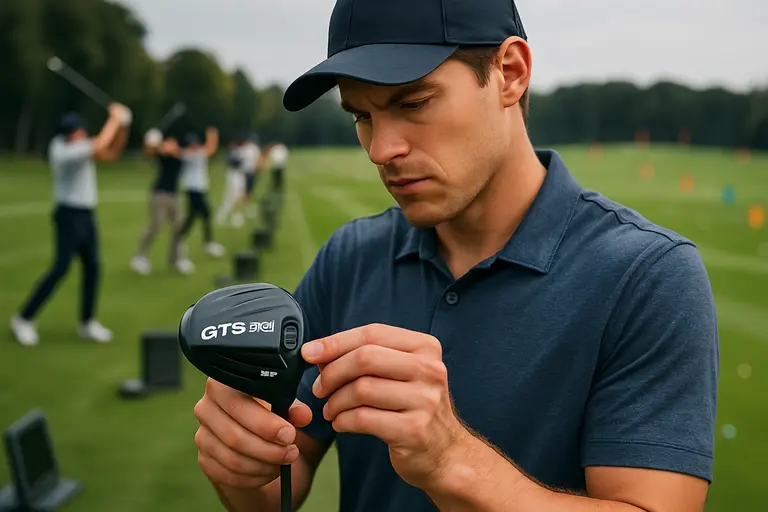
The SureFit hosel gives fitters a way to adjust loft and lie, which can change start line, face presentation, launch, and spin. That is useful, but it should not become random tinkering. I like to start with the golfer’s baseline setting, record a clean sample, then change one variable at a time.
For example, if a player launches the ball too low from the fairway but likes the tee flight, loft change may help one role and hurt another. If the player starts the ball too far right, lie and face delivery need to be reviewed together. Adjustability works best when the fitter can explain what changed and why the ball flight responded.
The GTS300 Mini Driver also raises the same forgiveness question that applies to full-size drivers: bigger or newer does not automatically mean better fit. A club can have more stability on paper and still be wrong for a golfer’s delivery. Our piece on driver forgiveness myths covers that same point from a broader driver-fitting angle.
Sound, Feel, And Player Feedback
Titleist notes sound and feel as part of the design package, and that is not a throwaway category. Players respond to feedback. A head that sounds too sharp, too muted, or too unfamiliar can change tempo, even if the launch numbers look fine in a short test.
In a fitting bay, I treat sound and feel as support evidence, not the whole case. If a player loves the feel and the data supports the result, that is a strong sign. If a player loves the feel but the ball flight is unstable, the fitter still needs to protect the scorecard. The best long-club choice is the one the golfer can repeat, not the one that wins a one-swing beauty contest.
Practical Fitting Notes For Titleist GTS300 Testing
The GTS300 Mini Driver is best viewed as a precision long-club option with driver-like speed goals and fairway-wood-like versatility demands. Its larger 305cc head, composite crown, forged L-Cup face, elongated tail, and SureFit hosel give fitters several meaningful variables to test. None of those features guarantee a lower score or a distance gain, but each creates a clear fitting question.
Start by deciding what problem the club is supposed to solve. If the golfer needs a safer tee shot, compare it to driver dispersion and 3-wood carry. If the golfer wants a second-shot club, test turf launch and low-face contact before making room in the bag. If the player wants one club to handle both jobs, require proof in both settings.
That is the right way to judge the GTS300 Mini Driver: not by hype, and not by head size alone, but by the shots it adds, the misses it reduces, and the confidence it gives the golfer when the fairway narrows.