The GTS300 Mini Driver sits in a very specific fitting lane: it is not a full-size driver replacement for every golfer, and it is not just a strong 3-wood with a larger badge. Titleist released the club on July 23, 2026, with a 305cc head, a composite crown, a forged L-Cup face, SureFit adjustability, and a dual-weight system aimed at controlling launch, spin, and stability. Titleist also says player feedback from Justin Thomas and Cameron Young influenced the design direction, especially around stability and forgiveness Titleist newsroom.
From a fitting bench, that makes the club interesting for a player who wants a safer tee option, a more playable fairway-wood shape, or a bridge between driver and 3-wood. The fit is not automatic. The right question is not whether the head is new or larger than the prior GT280 model. The right question is whether its launch window, strike pattern, and dispersion beat the club it is trying to replace.
GTS300 Mini Driver Design Priorities
Titleist’s design story starts with size. The 305cc head gives the club more footprint than a conventional fairway wood while staying well under a modern 460cc driver. In fitting terms, that can help the player who feels boxed in by a small fairway-wood face but uncomfortable with a full driver on tighter tee shots. Head volume alone does not make a club fit, but it changes the visual setup, strike confidence, and forgiveness potential.
Where The GTS300 Mini Driver Fits
The GTS300 Mini Driver should be tested as a purpose-built club, not judged by one perfect launch-monitor strike. For many players, a mini driver earns a bag spot only if it tightens tee dispersion while keeping enough ball speed to justify replacing a fairway wood or specialty driving club. For others, it may need to be useful from the turf. Those are two different assignments, and the fitting process should separate them.
The composite crown matters because it gives engineers room to move mass. The research notes point to weight distribution and a deeper center of gravity as part of the design package. A deeper CG can support launch and stability, but the golfer still has to match loft, shaft, and strike location. If a player delivers too much dynamic loft or adds excessive spin, a forgiving head can still produce a weak flight. If a player hits low on the face, the face design becomes more relevant.
Face And Crown Construction
The forged L-Cup face is one of the more fitting-relevant pieces because Titleist positions it as a way to maintain ball speed and launch conditions on low-face impacts. That is useful because mini drivers often tempt golfers to hit them from tight lies, where strike tends to move lower on the face than it does from a tee. The fairway-use claim still needs to be tested. A player with a shallow attack and enough speed may like it from the turf. A steeper player may see the head as mainly a tee club.
For comparison work, I would also have the golfer read up on why driver head size is only part of fitting. The point applies here. Volume, crown material, and face shape are part of the answer, but launch, spin, strike, and start line decide whether the club has a real job in the bag.
Forgiveness, Launch, And Adjustability
The forgiveness story is tied to the larger 305cc frame, the composite crown, the deeper CG direction, and the adjustable weighting. Titleist’s dual-weight system uses 11g and 3g weights, giving fitters a way to influence center-of-gravity behavior. The research notes describe the system as a method for launch and spin control. That does not mean every player should start moving weights immediately. Baseline testing should come first.
SureFit Hosel Settings
The GTS300 Mini Driver is compatible with Titleist’s SureFit hosel, which allows loft and lie changes. In a proper session, I want to see three things before changing the sleeve: face contact, launch direction, and curvature. If the golfer is consistently striking the ball high toe, a lie or shaft change may be more useful than chasing loft. If contact is centered but the flight launches too low, loft adjustment becomes more relevant.
Hosel settings should be measured against the golfer’s intended use. A tee-only player may accept a flatter, lower-spinning setup if it controls the left side and produces a strong flight. A player who wants fairway use may need more launch and a playable descent. The same head can be set up two very different ways, which is why a mini driver fitting should include real targets rather than just distance sorting.
Weight Position Testing
The 11g and 3g weights should be tested with the same shaft and ball first, so the fitter can isolate what the head is doing. I would track carry, total distance, spin, launch, peak height, descent angle, and left-right dispersion. Just as important, I would mark the face. If moving weight improves strike pattern, that is a meaningful finding. If it only produces one longer shot and several loose misses, it is not a better fit.
Golfers often ask whether a mini driver is “more forgiving” than a 3-wood. The honest answer is: sometimes. The larger head can help, but the longer playing length, loft choice, and delivery pattern can erase that benefit. The more useful comparison is not marketing category versus marketing category. It is your current tee club versus this head, hit to the same target, with poor swings included.
Shafts, Price, And Build Choices
Golf Digest reported standard shaft options including True Temper Project X Denali Black and Mitsubishi Tensei 1K series, with pricing listed at $549 for standard shaft options and $749 for premium Graphite Design Tour AD shafts Golf Digest equipment report. Those numbers are useful shopping context, but shaft fit is still the more important build decision.
| Fitting Area | What To Check | Why It Matters |
|---|---|---|
| Head Size | Confidence, strike spread, tee height | A 305cc head changes setup and forgiveness potential |
| Face Contact | High, low, heel, toe patterns | Low-face performance matters if turf use is part of the plan |
| Hosel Setting | Loft, lie, start line | SureFit changes can tune launch and direction |
| Weights | Launch, spin, dispersion | The 11g and 3g system can change head behavior |
| Shaft | Weight, profile, feel, timing | The head only works if delivery stays repeatable |
Do not treat the premium shaft as the automatic winner. A higher-cost option may fit some players, but a fitter should prove it with delivery consistency and dispersion, not just one faster ball-speed number. If graphite profile testing is part of the session, this related note on graphite shafts and fit is a useful companion because it frames shaft choice around comfort, speed, and launch-monitor checks.
Testing The GTS300 Mini Driver In A Fitting
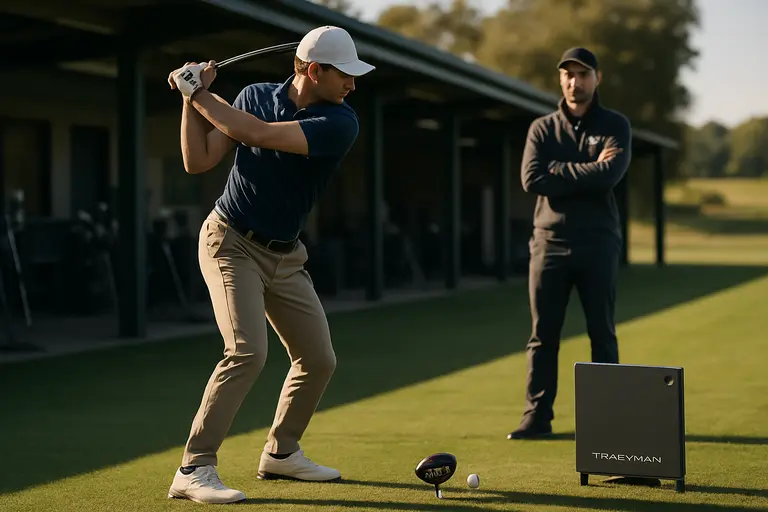
A good test plan for the GTS300 Mini Driver starts with the golfer’s current setup. I would compare it against driver, 3-wood, and any existing driving club. The golfer should hit enough shots to show misses, not just best swings. A five-ball test can make almost anything look promising. A better session uses multiple blocks, face tape or spray, and target-based scoring.
- Tee test: compare fairway hit pattern, start line, curve, carry, and total distance against the gamer driver and 3-wood.
- Turf test: hit from a fairway lie only if the golfer expects to use the club off the deck.
- Miss test: keep low-face, heel, and toe strikes in the data instead of deleting them.
- Build test: change only one variable at a time, such as hosel setting, weight setup, or shaft.
The most useful result may be a tighter tee-shot pattern rather than a longer one. For some players, a mini driver can create a more comfortable shape on narrow holes. For others, the same club may fly too close to driver distance and leave a gap below it. Bag mapping matters. If the mini driver replaces a 3-wood, the golfer still needs to know what happens on long par-5 second shots and long par-4 approaches.
Players who like to compare equipment notes beyond the fitting bay can also follow related gear coverage at Cutting Ball, where discussions on ball flight, strike quality, and equipment changes often intersect.
GTS300 Mini Driver Fit Verdict
The GTS300 Mini Driver makes the most sense for golfers who need a confident tee club with more head size than a fairway wood and more control intent than a full-size driver. Its 305cc head, composite crown, forged L-Cup face, SureFit hosel, and dual-weight system give a fitter several useful tools. None of those tools guarantees better scoring or extra distance. They simply create more ways to match the club to the player.
The best fit candidates are golfers who can define the job clearly. If the job is tighter tee dispersion, test it against driver and 3-wood on the same target line. If the job is fairway use, test low-face strike and launch from the turf. If the job is replacing a strong fairway wood, check the gap to the next club down. The club’s design gives it a real place in the fitting conversation, but the launch monitor and the course plan should decide whether it belongs in the bag.