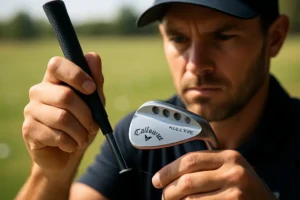
As of September 8, 2026, a Black Gold Fitting is best understood as a scheduled, brand-supported club session rather than a walk-up demo day. Black Gold Golf Club in Yorba Linda lists manufacturer-specific fitting events roughly once per month, depending on weather and manufacturer availability, with brands such as Titleist, TaylorMade, and Srixon/Cleveland involved. The next listed event is the Titleist Club Fitting Experience on Wednesday, September 23, 2026, featuring Titleist GTS™ Drivers & Fairway Woods, and appointments are required through the golf shop, according to Black Gold’s fitting calendar.
That appointment requirement matters. A useful fitting is not just a fitter handing you a new head and asking whether it feels good. It should create enough structure to compare your current club, test a limited set of realistic alternatives, and identify whether the data supports a change. For most golfers, the value sits in narrowing choices: loft, shaft weight, shaft profile, head model, lie angle, wedge grind, or fairway wood setup. The session does not need to promise a score drop to be worthwhile. It needs to give you clearer decisions.
How Black Gold Fitting Events Work
Booking A Black Gold Fitting Appointment
A Black Gold Fitting appointment should start before you arrive. Because appointments are required in advance and handled through the golf shop, golfers should be ready to explain what club category they want to test and what problem they are trying to solve. A driver fitting has a different rhythm than an iron fitting. A wedge clinic has a different goal than a fairway wood comparison. If you arrive saying only that you want “something better,” the fitter has to spend time identifying the target before testing can begin.
Bring the club you currently play, your usual golf balls if possible, and a short description of your normal miss. For example, a player who launches the driver low with too much right curve needs a different test plan than a player who hits it high with spin. The fitter may still find that the current club is close to correct. That is not a failed session. Good fitting often confirms what should stay in the bag as much as it identifies what should change.
Manufacturer Days Versus General Fitting
Manufacturer-specific events are useful because the fitter can work inside one brand’s head, shaft, and setting matrix. That can create a clean test if you already have interest in a specific line, such as Titleist woods or Srixon/Cleveland wedges. The trade-off is that a brand day may not compare every possible head on the market. Golfers should understand that distinction. A manufacturer event is not always the same as a full multi-brand studio fitting.
That does not make the format weak. It simply means the questions should fit the setting. On a Titleist woods day, for instance, strong questions include launch window, spin control, face contact, start line, shaft weight, and whether driver or fairway wood changes create better gapping. Less useful questions are broad claims about which brand is “best.” There is no single best club without a golfer, a delivery pattern, and a ball-flight goal.
Data, Turf, And Ball Flight Checks
TrackMan Numbers Worth Watching
Black Gold’s practice and fitting environment is tied to launch-monitor feedback. The Golf Range Association of America noted that the facility uses TrackMan technology among other tools to measure launch, ball flight, spin, and related fitting information in its Black Gold facility profile. Those numbers are useful only when they are read in context. A golfer can hit one perfect ball with nearly any club. The better question is what the pattern looks like across several swings.
For a driver or fairway wood session, pay close attention to launch angle, spin rate, carry distance, peak height, landing angle, ball speed, club speed, and dispersion. Strike location matters just as much. A head-and-shaft combination that produces one fast ball but several heel strikes may not help on the course. A slightly shorter build or different shaft weight can sometimes tighten contact, but that has to be tested rather than assumed.
How To Test A Change Without Chasing One Swing
The most common fitting mistake is reacting too strongly to the best swing of the day. Players see one long carry number and immediately want that setup. A better fitter will look at the cluster. Are the misses better? Is the launch playable? Does the ball curve less severely? Does the club return to the same strike area more often? If the answer is yes, then the club deserves more attention. If the answer is no, the one big number may be noise.
This is where a practical fitting mindset helps. The launch monitor is not there to flatter the golfer. It is there to separate a real pattern from a good swing at the right moment. If you want a deeper primer on which measurements matter, our breakdown of fitting metrics explains how launch, spin, dispersion, and purchase context fit together.
What To Bring And How To Read The Results
Your Current Clubs Are The Control Group
A fitting without your current club is missing the baseline. The fitter needs to know whether a new setup improves launch, spin, strike quality, distance control, or dispersion compared with what you already own. This is especially true for golfers who have adjusted to older equipment. A newer head may look better on paper, but the question is whether the player can deliver it consistently.
Do not hide your misses. If you usually hit a wipe fade under pressure, tell the fitter. If your 7-iron goes left when you swing hard, say that early. A good session is built around the shot you actually bring to the course, not the one you hope to show on a perfect range day. Fitters can only work from the movement pattern they see and the information you provide.
Questions To Ask Before An Order
Before ordering any club, ask what changed and why. You should leave with a clear explanation of the recommended head, loft, shaft, length, lie, grip, or wedge setup. You should also understand what the fitter rejected. If three shafts were tested and one performed best, ask what separated it from the others. Was it launch? Spin? Face contact? Start direction? Tempo match? The answer should be specific enough that you can explain it later.
- Ask which numbers improved against your current club, not just the best shot of the session.
- Confirm build details such as length, loft, lie, shaft model, flex, grip, and any adjustable hosel setting.
- Ask whether the recommendation is meant to solve distance, dispersion, launch, gapping, or turf interaction.
- For wedges, ask how the fit relates to pitching, chipping, bunker play, and the course conditions you face most often.
Where Wedges And Full-Bag Needs Differ
Wedge Clinics Need Short-Game Context
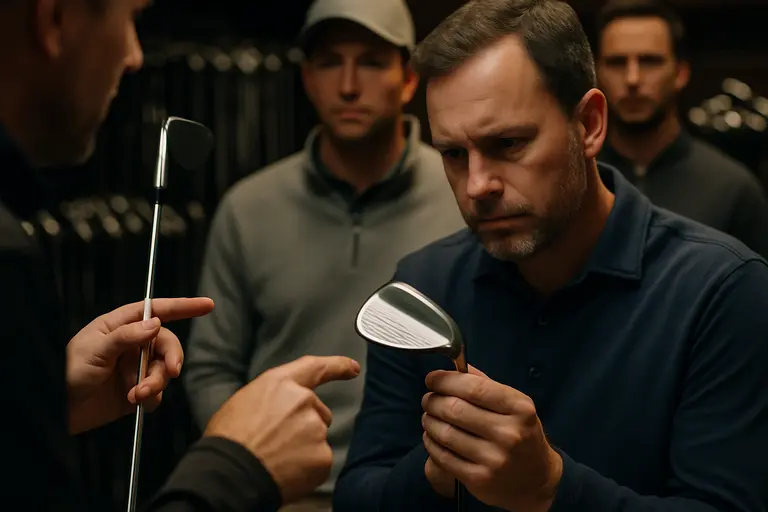
Black Gold has also been associated with wedge fitting and clinic formats in the research notes for the facility. That type of session should be judged differently from a driver day. Wedges are not only about full-swing yardage. They are about turf contact, bounce use, face control, partial carry numbers, bunker comfort, and how the wedge set blends with the pitching wedge or gap wedge already in the bag.
A wedge that looks perfect on a mat can behave differently from grass or sand. That is why short-game context matters. If your home course has firm turf, a high-bounce setup may not feel the same as it does from soft lies. If you play courses with fluffy bunkers, sole design can become more relevant. The fitting goal is not to copy a tour player’s wedge stamping or loft setup. It is to build a scoring set that covers the shots you actually hit.
Full-Bag Fitting Should Respect Gapping
A full-bag review is more about spacing than replacing everything. The golfer may only need one fairway wood gap cleaned up, one hybrid changed, or one wedge loft adjusted. Iron fittings should pay attention to carry distance intervals, peak height, descent angle, and whether the longest irons are still useful. Many amateur sets fail at the top end because two clubs travel nearly the same distance, or at the bottom end because wedge gaps are too wide.
Golfers who enjoy following facility operations across different sports can check out our network’s coverage of hockey at Dasher’s Hockey, but when it comes to golf, the fundamental lesson stays the same: making informed equipment choices is about analyzing measured performance, player feedback, and a detailed build sheet.
Black Gold Fitting Takeaways For Golfers
Treat a Black Gold Fitting as a decision session, not a buying shortcut. The facility’s event model gives golfers access to manufacturer fitting days, PGA-staffed support, and launch-monitor feedback, but the golfer still has work to do. Arrive with your current clubs, know your common miss, be honest about your playing goals, and ask for the reason behind every recommendation.
The Titleist event scheduled for Wednesday, September 23, 2026, is a clear example of how these experiences are structured: appointment-based, brand-specific, and focused on matching components to ball flight. That format can be valuable for a golfer looking at drivers or fairway woods, but it should still be judged by the quality of the comparison, not by the shine of the newest head.
No fitting can guarantee lower scores or extra yards. What it can do is reduce guesswork. If the data, strike pattern, and on-course needs point in the same direction, the recommendation has a stronger foundation. If they do not, a smart golfer waits, asks more questions, or keeps the current club in play. That is the fitting-first way to use an appointment at Black Gold: measure carefully, test honestly, and order only when the evidence supports the build.