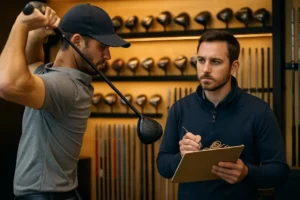
The custom fitting impact on golf equipment sales became clearer after the June 23, 2026 Golf Datatech study, which reported that 80% of serious U.S. golfers had been custom fitted for clubs at least once, and 30% had been fitted in the prior 12 months. That is no longer a niche buying habit for low-handicap players with tour-level launch monitors at home. It is now a major part of how better equipment gets selected, priced, ordered, and kept in the bag.
For golfers, the useful takeaway is not that every new club needs a premium fitting session. It is that buying clubs without understanding the fitting process can make the price tag harder to judge. A driver, iron set, wedge, or putter purchase is now tied to more than a head model on a rack. Shaft options, lie angle, loft gapping, grip size, length, and build tolerances all affect whether the finished club fits the golfer standing over the ball.
Why Custom Fitting Impact Shows Up In Sales
Golf equipment sales have always been shaped by performance promises, brand cycles, and tour visibility. What changed by 2026 was the amount of buying activity flowing through a fitting bay before a golfer ordered a premium club. The Golf Datatech study released on June 23, 2026 said custom fitting represented between 30% and 50% of U.S. premium golf club sales, a range that shows how central fitting had become to the high-end equipment purchase path, according to the Golf Datatech release.
Custom Fitting Impact Starts Before The Sale
The custom fitting impact starts before a golfer chooses a model. In a sound fitting, the first job is to learn the player’s miss pattern, speed range, strike location, launch window, and yardage needs. A fitter should not simply hand over the newest head and chase one long shot. The more useful work is narrowing the field to combinations that produce repeatable launch, spin, carry, descent angle, and dispersion.
That process changes the sales conversation. Instead of asking, “Which driver is longest?” the fitter and golfer can ask, “Which driver keeps the playable miss tighter?” Instead of picking irons by brand loyalty alone, the player can compare sole width, loft structure, peak height, stopping power, and left-right pattern. A club can look attractive in a catalog and still be wrong for the golfer’s delivery.
Irons And Drivers Lead The Fitting Habit
The 2026 research identified irons and drivers as the club categories with the highest fitting penetration, at 71% for irons and 56% for drivers. That matches what I see in fitting rooms: golfers often start where the financial risk feels highest. Iron sets are expensive enough that most players want reassurance before ordering, while drivers get attention because off-center strike, launch, and spin can be exposed quickly on a launch monitor.
Hybrids, wedges, and putters remained less fitted in the research notes, despite growing interest. That gap matters. Many golfers spend hours comparing iron shafts and then buy wedges by loft alone, even though sole grind, bounce, shaft weight, and gapping can affect scoring shots. Putters are another blind spot. Length, lie, loft, head shape, toe hang, and aim bias all influence start line and distance control. A golfer does not need to overpay for a fitting, but ignoring those categories can leave easy questions unanswered.
Pricing Transparency And The Premium Club Buyer
Price clarity is where the fitting boom gets most practical. A fitting fee is one number. The finished club order is another. Golfers should separate the cost of the session from the cost of the build, then ask which shaft, grip, adapter, length, lie, loft, and swingweight choices are included or upcharged. That is the only way to compare a local shop, a brand demo day, an independent fitter, and a national chain on fair terms.
Ask What The Fee Covers
Some fittings are designed as paid diagnostic sessions. Others may credit the fitting fee toward a purchase. Some are single-category sessions, while others cover the full bag. The research supplied here notes that pricing transparency varies across shop types, which is not surprising. A golfer booking an appointment should ask whether the session includes launch monitor data, shaft matrix access, lie and loft checks, written specs, outdoor ball flight, and post-build verification.
A good price is not always the lowest fee. A $0 fitting that pushes one stock option without measuring the golfer properly may not be a bargain. A higher-fee session can be worth considering if it gives the player clear data, multiple no-upcharge comparisons, and an order sheet that can be reviewed before payment. For a deeper look at fee structure, booking questions, and build costs, our related piece on custom fitting pricing lessons is a useful companion.
Repeat Fittings Change The Value Equation
The same June 2026 study reported that among golfers fitted within the previous two years, more than 85% said they planned to be fitted again. That repeat intent is a key part of the custom fitting impact. Fitting is becoming less like a one-time event and more like a service golfers revisit as swings, speed, injury status, goals, and equipment age change.
That does not mean a player should replace clubs every year. In fact, a well-fit set can make a golfer more patient. If the lofts are gapped, the lie angles make sense, the shafts match the player’s tempo, and the ball flight is playable, there may be less pressure to chase every new release. The smarter habit is periodic evaluation: check loft and lie, confirm gapping, look at strike pattern, and decide whether the current set still serves the scoring job.
What Market Data Means In The Fitting Bay
Market data can make custom fitting sound like a sales machine, but the golfer’s job is to bring the conversation back to performance evidence. The fitting bay should answer specific questions. Is the current driver launching too low? Are iron shots falling out of the air? Is the 6-iron carrying too close to the 7-iron? Are wedges leaving a 20-yard gap? Is the putter aimed consistently from the player’s setup?
The custom fitting impact is strongest when those questions are tied to measurable results and course needs, not just a purchase order. Serious golfers may enter the session with a brand in mind, but the best outcome is a spec sheet that makes sense. That might lead to new clubs. It might lead to a loft adjustment, a lie change, a shaft change, or no immediate purchase at all.
- Before booking: ask whether the fitting is indoor, outdoor, or both, and whether premium shafts carry added build costs.
- During testing: compare average results, not only the single best shot from each combination.
- Before ordering: request final specs in writing, including head, shaft, flex, length, lie, loft, grip, and any added charges.
- After delivery: verify the build if the shop offers that service, especially for loft, lie, length, and swingweight.
The U.K. trade coverage of the same custom fitting trend also reported that fitting continued to shape equipment sales, including the 30% to 50% premium-club sales range from the 2026 study, as noted by Golf Retailing. That matters because fitting is not only a U.S. retail story. It reflects a broader shift in how golfers expect equipment to be explained before they buy.
How Golfers Should Read Premium Equipment Pricing
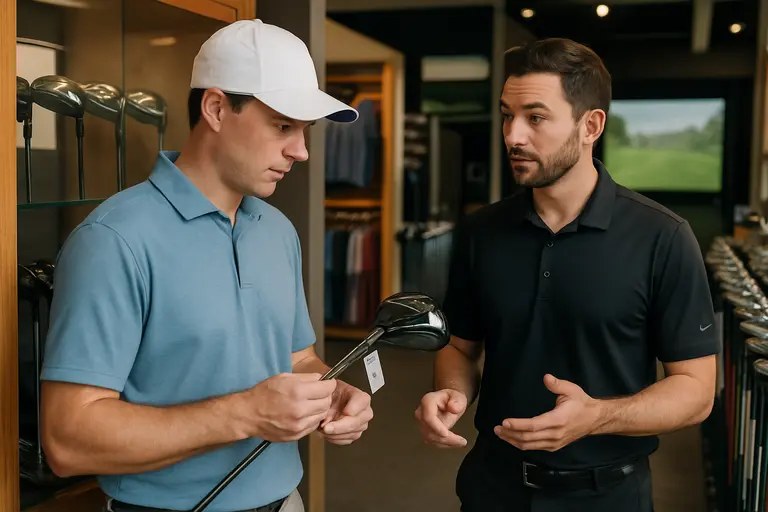
Premium equipment pricing can look confusing because two golfers may order the same head and pay different final totals. The difference may come from shaft choice, grip choice, build services, fitting fee policy, or whether any components are standard or aftermarket. A transparent fitter should be able to show the player which options are included and which add cost.
Data Should Support The Build Sheet
Launch monitor data is helpful only if it supports the build sheet. Ball speed, launch angle, spin rate, carry distance, total distance, peak height, landing angle, and dispersion can all inform the decision. But players should also care about strike location, face control, comfort, turf interaction, and whether the club produces the desired shot under normal effort.
That is where a practical fitter earns trust. If two shafts perform almost the same and one costs less, the golfer deserves to hear that. If a premium shaft produces better delivery and tighter dispersion for that player, the golfer should see the evidence before agreeing to the price. No fitting can promise lower scores or extra distance, but it can reduce guesswork.
Sports Buyers Are Getting More Data Literate
Golf is not alone in this shift toward data-aware buying and fan behavior. Across our sports network, insights from the NBA Playbook offer a similar view of decision-making, emphasizing how analysis can lead to smarter choices both on the court and in equipment purchases. Golf equipment buyers are asking their own version of those questions: what is the measurable fit, what is the cost, and what problem does the purchase solve?
For club fitting, that means the best customer is not the one who accepts the most expensive option. It is the one who asks better questions. What changed versus the current club? Was the test done with the golfer’s gamer ball or a range ball? Were mishits included in the average? Does the recommended iron loft structure create proper gaps through the wedges? Is the driver built to the same length that was tested?
Custom Fitting Impact For Smarter Club Buying
The custom fitting impact on equipment sales is real, but golfers should treat it as a decision tool rather than a buying command. The strongest case for fitting is not hype. It is the ability to connect a golfer’s delivery to club specifications, then make the price more understandable before money changes hands.
As of September 26, 2026, the supported data showed high adoption among serious U.S. golfers, major influence on premium club sales, and strong intent among recently fitted players to return for future fittings. Those are meaningful signals for retailers and brands. For golfers, the message is simpler: book with a clear goal, demand clear pricing, compare averages instead of outliers, and leave with specs you understand.
A fitting cannot guarantee better scoring. Golf still depends on strike, decision-making, practice, course management, and the player’s ability to repeat motion under pressure. But a clear fitting can help remove poor equipment matchups from the list of problems. In a market where premium clubs cost enough to deserve scrutiny, that may be the most practical value of the fitting boom.