Fitting metrics should make a club fitting easier to understand, not harder to trust. MyGolfSpy’s 2024 Fitting Survey, published on October 2, 2024, gives golfers a useful look at what actually happens before, during, and after a fitting. More than 80% of respondents said they had experienced at least one club fitting, which means the fitting bay is no longer only for low-handicap players or gear obsessives, according to MyGolfSpy’s fitting survey.
The useful lesson is not that every golfer needs to buy new clubs after one session. It is that a better fitting conversation starts before the first shot. Budget, travel distance, the clubs being tested, and the data a fitter chooses to explain all shape whether the session feels clear. Launch monitor numbers can help, but only if the golfer knows which numbers are being used and why.
Why Fitting Metrics Matter Before You Book
The booking step sets the tone. A golfer who walks in without asking about cost, test options, or goals can still get a productive session, but the survey suggests many fittings could be clearer at the start. Most fitters discussed performance objectives and current clubs, but only 25% of respondents said the fitter asked about budget before the fitting.
Fitting Metrics Start With Budget
Fitting metrics are not only launch, spin, and dispersion. For the player paying the bill, price clarity is part of the fit. The MyGolfSpy survey reported that 35% of golfers who had been fitted were fitted for free, while roughly another 30% had the fitting cost embedded in the club purchase. That means more than 65% essentially paid nothing extra for the fitting itself.
That does not mean every fitting is free. It means golfers should ask direct questions before booking: Is there a fitting fee? Is it credited toward purchase? Are premium shaft or build options priced separately? For more on how those questions affect the real cost of a session, FS Golf has a fitting-first look at custom fitting pricing.
Local Access Changes The Decision
Travel also matters. In the survey, 45% of respondents traveled less than 10 miles for their most recent fitting, 33% traveled between 11 and 25 miles, and more than 86% stayed within 50 miles. That tells us something practical: most golfers are not planning a destination fitting. They are using local access, which makes pre-fitting communication even more valuable.
For golfers interested in data-driven analysis across different sports, a visit to World Football Idol shows how sport enthusiasts benefit from properly guided insights: having access to data is one thing, but knowing which questions to ask can greatly enhance the interpretation and usefulness of that data.
The Numbers Golfers Hear Most Often
Distance remains the headline number in many fittings. The survey found that 78% of fitters discussed distance. Ball speed, launch angle, spin rate, and dispersion were each mentioned between 67% and 72% of the time. Those are familiar launch monitor categories, and they can be helpful, especially when a golfer is comparing heads, shafts, lofts, or set makeup.
Distance Is Common, But It Is Not Enough
A good fitting should not treat distance as a stand-alone answer. A longer shot that creates wider misses may not suit the golfer’s course, speed, or scoring pattern. That is why fitting metrics need context. Ball speed can show efficiency. Launch angle can show whether the ball is starting in a usable window. Spin rate can explain whether shots are floating, falling, or curving too much. Dispersion can show whether a club is producing a pattern the golfer can aim with.
None of those numbers guarantees a lower score. They simply give the fitter and golfer a better way to compare options. If two iron builds carry similar distance but one produces a tighter pattern and more playable height, the better fit may not be the one with the longest single shot.
Peak Height And Descent Angle Need More Air Time
The survey also points to numbers that may not get enough discussion. Peak height was discussed 36% of the time, and descent angle was discussed 30% of the time. Those numbers matter because a shot has to finish in a useful place, not just fly a pleasing yardage. For irons and hybrids, descent angle can influence whether a ball has a chance to hold a green. For slower-speed players, peak height can be part of the answer when long irons or fairway clubs stop carrying far enough apart.
Strokes Gained appeared only 1.4% of the time in fitting discussions. That is striking because Strokes Gained can connect equipment choices to scoring context, but it also requires a level of player data that many golfers may not bring into a standard retail fitting. If a golfer tracks fairways, greens, approach proximity, or common misses, that information can help the fitter interpret launch monitor results with more care.
Which Clubs Get Fit First
The survey shows a clear order in how golfers approach fittings. Irons lead by a wide margin, with about 92% of golfers reporting they had been fitted for irons at least once. Drivers followed at about 80%. Those two categories make sense as starting points because they are high-use, high-cost purchases with many head, shaft, loft, lie, and set makeup decisions.
Irons And Drivers Lead The Conversation
Iron fitting often gives a fitter many clues: strike location, lie interaction, carry gaps, launch, spin, and how a player handles different head shapes. Driver fitting is more concentrated but still data-heavy, with ball speed, launch, spin, face delivery, and shot pattern all sitting near the center of the discussion.
The survey also noted where golfers tend to get fit. Off-course pro shops were the most common setting, while Club Champion accounted for more than 14% of all fittings among fitting chains. Big-box stores such as Golf Galaxy, at about 5%, and PGA TOUR Superstore trailed behind in the survey sample. The lesson for golfers is simple: compare the process, not just the sign on the building.
Wedges, Hybrids And Putters Lag Behind
Wedges, hybrids, and putters were fitted much less often. The survey listed hybrids at 31%, putters at 35%, wedges at 37%, and utilities or utility irons at about 6.5%. That gap matters because these clubs fill scoring and gapping roles. A wedge that does not blend with iron lofts can leave awkward yardages. A hybrid that flies too close to a fairway wood or long iron may not solve the bag problem. A putter that poorly matches aim, length, or stroke tendencies can make distance control harder to manage.
Price, Pressure And Purchase Decisions
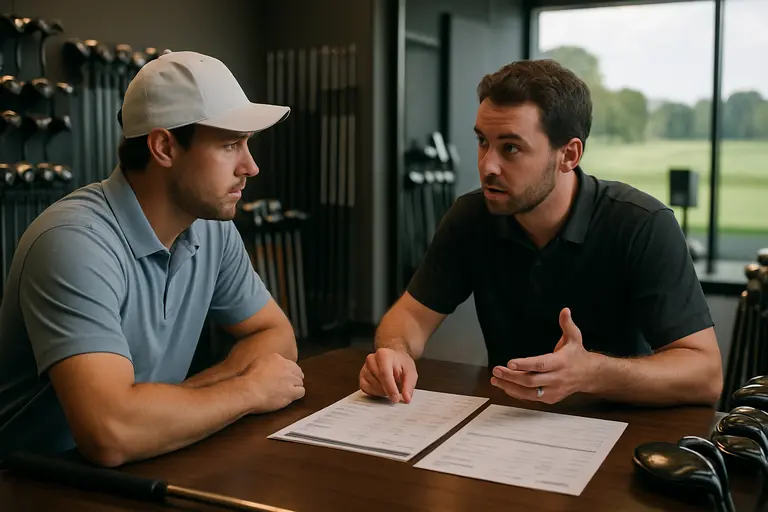
One useful survey finding is that fitting pressure may be lower than many golfers fear. On a 1-to-10 scale, where 1 meant no pressure to buy, the average pressure reported by golfers was just 2. That does not remove the need for price clarity, but it does suggest many sessions are not the high-pressure sales appointment some golfers picture.
Ask About Fees Before The Session
Golfers who have not been fitted still cite cost as a major concern. More than 41% of those who had not had a fitting said cost was the main barrier. About 30% said they did not believe they were good enough to warrant being fitted. Both points deserve a practical answer: ask about the fee structure first, and remember that fitting is about matching equipment to the swing you bring, not proving you are an elite player.
- Ask whether the fitting fee is free, separate, or credited toward purchase.
- Ask which club categories will be tested during the session.
- Ask whether budget will be discussed before product recommendations.
- Ask which launch monitor numbers will guide the comparison.
- Ask whether you can receive a written spec sheet after the fitting.
Buying After The Fit Is Common
After fittings, 85% of golfers said they bought the clubs they were fit for. For those who did not buy, 33% cited cost or finding a cheaper deal, while fewer than 13% pointed to lack of trust or a bad experience. That suggests the main friction is often price, not the idea of fitting itself.
This is where a golfer should separate the fitting recommendation from the buying decision. A good spec sheet can be useful even if the purchase waits. Length, lie, loft, shaft model, flex, grip, and set makeup can all shape the final order. If the recommended build is outside budget, ask the fitter what parts of the build are most essential and what alternatives keep the intent of the fit intact.
Fitting Metrics For A Clearer Session
The best use of fitting metrics is not to chase the biggest number on the screen. It is to build a clear case for why one club setup fits the golfer better than another. Distance may start the conversation, but ball speed, launch angle, spin rate, dispersion, peak height, and descent angle can make the recommendation easier to understand.
A golfer booking a fitting should expect two kinds of clarity: performance clarity and price clarity. Performance clarity means the fitter explains what the data shows and how it applies to the player’s actual misses. Price clarity means the golfer understands the session fee, possible purchase credit, and the cost of any recommended build before feeling boxed in.
The MyGolfSpy survey does not say every fitting is perfect. It does show that fitting is common, usually local, often low-pressure, and frequently tied to a purchase. For golfers, the practical move is to arrive with goals, a budget range, current club information, and a willingness to ask what each number means. Used that way, the launch monitor becomes less of a scoreboard and more of a fitting tool.