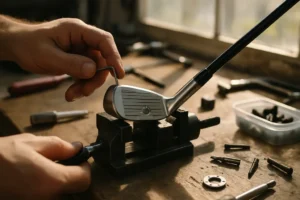
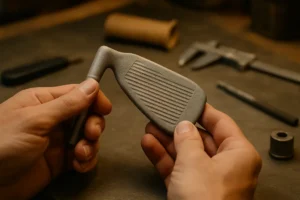
Golf Shaft Labels are useful only if golfers treat them as a starting point, not a forecast. The recent criticism of simple “high launch,” “low spin,” and similar shaft tags is not anti-technology. It is a reminder that the golfer’s motion, strike pattern, release, and delivery often decide the shot before the printed shaft category has much say. In a fitting bay, I want the label on the shaft, but I trust the ball flight, the strike map, and the player’s feedback more.
The issue is easy to see during driver and fairway wood fittings. A player may test a shaft sold as low spin and produce more spin because the feel changes timing, strike location, or face delivery. Another player may test a higher-launch profile and hit it flatter because the shaft helps them deliver the club differently. That does not make the shaft bad. It means the label is too simple for the way real swings work.
Why Golf Shaft Labels Can Mislead
Golf Shaft Labels Are Not Launch Guarantees
The strongest point from the recent critique is that launch and spin labels often fail to predict actual performance. A Golf Monthly critique argues that these categories can clash with real-world results because players react to shaft feel in different ways. That matches what fitters see often: two golfers with similar club speed can need very different profiles because their tempo, transition, and release are not the same.
Golfers tend to read a label as a promise. A fitter reads it as a clue. If a player loads the shaft aggressively from the top, the timing need is different from a player with a smoother transition. If a player releases early, the launch and spin result may come more from delivery than from the static shaft description. If the strike is low on the face, spin can jump or launch can fall regardless of what the shaft marketing says.
The Shaft Works As A Timing Tool
A practical way to view the shaft is as a timing mechanism. The shaft can change how the player senses the clubhead, how confidently they transition, and how repeatably they find the center of the face. That is why a shaft that looks right on paper can fail quickly in a fitting, while another option with a less obvious label can tighten contact.
Golf Shaft Labels can still be helpful for sorting the first few test options. A fitter may start with broad profile ideas based on speed, tempo, release, and the player’s current ball flight. But the session should not stop there. The right test asks whether the player can deliver the club consistently, not whether the product tag sounds correct.
Testing Golf Shaft Labels With Data
Golf Shaft Labels In A Bay Test
Launch-monitor data gives the fitting conversation a better base. The number that matters is not one isolated shot. It is the pattern across several swings: launch, spin, ball speed, strike location, start direction, curve, and carry consistency. A shaft that produces one impressive ball can still be a poor fit if the player cannot repeat the delivery.
In a proper test, I would rather compare patterns than chase the lowest spin number on the screen. Too little spin can make a driver fall out of the air for some players, while too much spin can cost control for others. The target window depends on delivery, speed, head loft, strike, and course needs. That is why the fitter has to watch the player as much as the monitor.
- Strike quality: Where the ball meets the face can change launch and spin more than the shaft label suggests.
- Tempo and transition: The same shaft may feel stable to one player and difficult to time for another.
- Release pattern: How the clubhead is delivered into impact can change trajectory more than a broad shaft category.
- Head settings: Loft and weighting changes may solve a launch or spin issue more directly than changing shafts alone.
This is also why graphite shaft testing should not be treated as a one-swing decision. Players who are thinking about lighter builds, different bend profiles, or comfort-driven changes can use the same evidence-first process described in our graphite shaft fit notes. Feel matters, but it should be checked against contact, dispersion, and launch behavior.
Head Loft And Weighting Still Matter
One common mistake is blaming the shaft for every trajectory problem. If a golfer launches the driver too low, a different shaft may help timing, but loft may be the cleaner adjustment. If spin is too high, strike location and head delivery may be the first places to look. Weighting can also change how the club feels during transition, which can alter delivery without needing a dramatic shaft change.
That is the fitting-first lesson. The shaft, head, loft, and weight setting are a system. Changing one piece can improve a pattern for one player and make another player worse. Driver forgiveness works the same way; head size or marketing terms alone do not settle the fit, which is why our driver forgiveness fitting notes focus on loft, strike, and dispersion instead of one spec.
What Recent Shaft Critiques Mean For Golfers

Player-Specific Results Should Lead
The recent shaft discussion should make golfers more curious, not more cynical. Modern shaft design can be highly refined, and brands such as Fujikura and Aretera offer models aimed at specific player needs. The caution is that a product story is not a fitting result. A shaft with stability-focused materials or a profile designed for a certain flight still has to match the golfer swinging it.
Player-specific performance is the key idea. Two golfers can test the same model and produce different launch and spin because they apply force differently. The same golfer can also change results as soon as the shaft affects confidence or timing. That is why fitters should collect enough swings to separate a real pattern from a reaction to something new.
Better Questions To Ask In A Fitting
A golfer booking a fitting does not need to arrive fluent in shaft engineering. It helps to arrive with better questions. Instead of asking, “Is this a low-spin shaft?” ask, “What did this shaft do to my strike pattern and delivery?” Instead of asking, “Which shaft launches highest?” ask, “Which build gives me the best repeatable window with my current swing?”
The same principle applies beyond golf equipment coverage. FS Golf is part of a broader sports network, and for readers who have an interest in hockey, related content is available at Dashers Hockey. In any sport, the valuable analysis comes from aligning data with the relevant performance queries.
Golf Shaft Labels In A Smarter Fitting Plan
Use The Label, Then Test The Player
Golf Shaft Labels are a starting line. The fitting starts to matter once the player hits shots and the evidence builds. A good fitter should use the label to choose sensible test candidates, then let launch data, strike quality, player feedback, and ball flight decide what stays in the test.
For golfers, the practical move is simple: do not buy a shaft only because the label appears to match the ball flight you want. Test it against your current gamer and at least one contrasting profile. Watch what happens to the center strike, not just the peak height. Pay attention to the misses, not only the best shot. Ask whether loft or weighting would solve the issue before assuming the shaft alone is the answer.
No shaft label can guarantee a lower score, a certain carry number, or a perfect trajectory. The right shaft can help the right player time the club better, but it has to be proven through testing. That is the fitting lesson worth keeping from the latest critique: trust the label enough to begin, then trust the player’s data enough to make the decision.