Cobra 3D Printed Irons have moved from a limited concept into a broader fitting option, and that matters more than the novelty of the printer. The key question for a golfer is not whether the head sounds futuristic. It is whether the construction gives a fitter more useful ways to match launch, spin, forgiveness, shape preference, and set makeup without asking the player to accept a head that looks wrong behind the ball.
Cobra’s first full commercial steel 3D-printed iron set, LIMIT3D, launched in mid-2024, according to the research notes provided. On January 6, 2026, Cobra then announced the 3DP MB and 3DP X models, with pre-sale starting that day and retail availability beginning on January 9, 2026, as reported in a PGA TOUR equipment report. That timing is worth noting because it shows Cobra treating the technology less like a one-off showcase and more like a product family that can be fit across different player needs.
Why 3D Printed Irons Change The Build Conversation
The central build difference is the head itself. Cobra’s 3DP iron heads are fully printed in 316 stainless steel through Direct Metal Laser Sintering, a metal additive manufacturing process that allows internal structures that cannot be made the same way through traditional casting or forging, according to Golf Digest’s equipment report. For fitters, the important point is not the manufacturing label. It is what that method permits inside the head.
The Lattice Is A Weight-Placement Tool
The internal lattice structure is the piece that changes the build conversation. Instead of starting with a mostly solid body and removing or adding weight through familiar cavities, plugs, badges, or tungsten ports, Cobra can create open internal geometry and then place mass where the design team wants it. The research notes state that saved weight can be redistributed toward the heel, toe, and lower sections of the head with tungsten weighting. That is meant to support a lower center of gravity and higher resistance to twisting, although any golfer still needs to test whether those traits show up in their own strike pattern.
This is where the standard for evaluation should rise. A head can be visually compact and still carry more stability than its shape suggests, but the player should not assume that forgiveness is automatic. Strike location, dynamic loft, attack angle, shaft delivery, and turf interaction all influence the result. A fitter should use face contact, carry distance, peak height, descent angle, and left-right dispersion to decide whether the head design is helping.
Feel Still Has To Be Tested
Cobra’s design approach also uses the lattice to influence sound and vibration. The research notes say the structure is intended to support the face while tuning impact feedback. That does not mean every player will describe the feel the same way. A golfer who has played forged muscle-backs for years may notice a different sensation than a player coming from a hollow-body distance iron. A fitter should let the player compare shots without leading the answer. If the sound, strike feedback, and distance control fit the player’s expectations, the build has a better chance of lasting beyond the first range session.
How The 3DP MB And 3DP X Fit Different Players
The 2026 expansion matters because Cobra did not present one head as the answer for everyone. The 3DP MB is described in the research as a muscle-back model for players seeking precision and feel, while the 3DP X is positioned closer to game-improvement needs. That split gives fitters a cleaner way to test profile preference without leaving the same material and construction story.
Fitting 3D Printed Irons Without Chasing Hype
Fitting 3D Printed Irons should start the same way as fitting any serious iron: establish the player’s delivery and miss. A player who controls center contact but wants a compact look may gravitate toward the MB shape. A player who misses low on the face, needs help launching longer irons, or wants more stability may fit better into X. The useful part is that Cobra’s 3DP family can support combo-set thinking, with different models placed in different parts of the bag while keeping a related visual and performance language, as the PGA TOUR report noted.
That combo option is the most practical fitting story here. Many golfers do not need the same head style from long iron through pitching wedge. A stronger player might prefer more help in the 4- and 5-iron, then move into a smaller scoring head. Another golfer may need the X shape through the mid-irons and only consider a more compact head in the shortest clubs. For a deeper companion piece focused on head construction and fit notes, see our related Cobra 3D printed irons build guide.
The risk is ego fitting. A muscle-back label can attract players who like the look but do not deliver the strike pattern to support it. A game-improvement label can push better players away even when the launch window and carry gaps are stronger. The printer does not remove that old fitting problem. It just gives the fitter more head options to test honestly.
Build Checks Before Ordering A Cobra 3DP Set
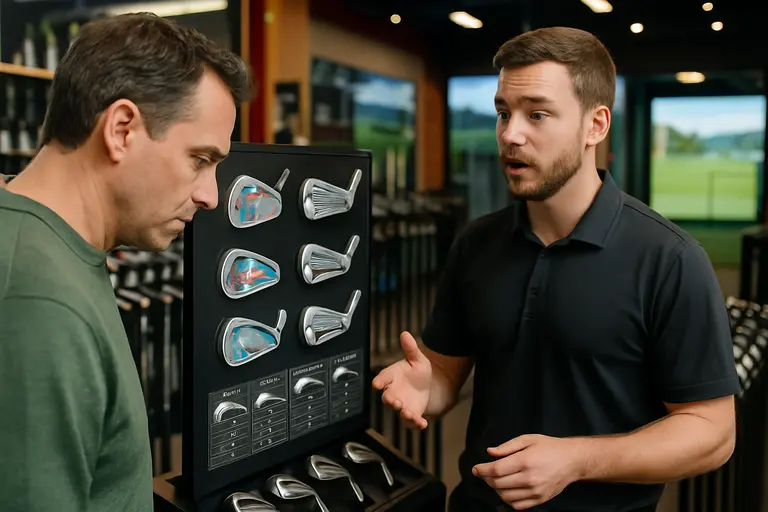
A premium head construction does not excuse loose build work. Length, lie, swing weight, grip size, shaft profile, and gapping still decide whether an iron set works. If the golfer is moving from a traditional forged cavity or blade into Cobra’s 3DP line, the first session should compare actual ball flight and not just spec sheets. The fitter should watch whether the golfer starts the ball on line, whether the toe or heel is taking over, and whether the longest iron in the proposed set still launches high enough to hold a green.
- Start with strike: map center, toe, heel, high, and low contact before judging forgiveness.
- Check gapping: test carry spacing through the transition irons, not only the 7-iron.
- Confirm lie dynamically: printed construction does not remove the need for proper lie fit.
- Compare head models: test MB, Tour, and X options where the set makeup changes.
- Respect feel feedback: sound and sensation can affect trust, even when launch numbers look good.
If you like keeping equipment terms straight as new build language appears, the related network site wikiapp.org can be a valuable reference. For this iron discussion, the working terms are DMLS, lattice structure, center of gravity, and moment of inertia. In the fitting bay, those terms only matter if they connect to shots the golfer can repeat.
Care and adjustment should also stay realistic. The research notes support that Cobra’s 3DP heads use 316 stainless steel, but they do not provide special bending, cleaning, or repair rules. A buyer should have loft and lie work handled by a qualified builder who can follow Cobra’s current service guidance. Do not assume every head material responds like a soft forged carbon-steel blade. If adjustments are needed after delivery, small measured changes are safer than broad guesses.
Cobra 3D Printed Irons Build Takeaways
Cobra 3D Printed Irons set a useful new standard because they make internal head structure part of the fitting conversation, not because they promise a universal performance jump. The DMLS process and lattice design allow weight placement that traditional methods cannot copy in the same manner, and the expanded 3DP family gives fitters more room to build blended sets by player need.
The best way to judge Cobra’s 3DP line is still simple: test the head that looks right, measure the shots that matter, and build the set around the weakest gaps. If the MB gives a skilled ball-striker the control and feedback they want, it earns its place. If the X produces better launch, tighter distance loss on mishits, or a cleaner long-iron transition, it earns its place. The technology is impressive, but the fitting result should decide the order.
That is the standard golfers should hold Cobra to now. The manufacturing story gets attention, yet the real value is whether a fitter can turn that construction into a set with playable launch, sensible gapping, stable mishits, and confidence at address. For a golfer comparing 3D Printed Irons against forged blades, cast cavity-backs, or hollow-body distance irons, the smart answer is not to chase the newest process. It is to test the process against the player’s delivery and let the build prove itself.