Walking into a custom club fitting should be enlightening. But often, it feels like a scene from a Kafka novel. You expect revelation but get sold an expensive parable instead.
The truth? A fitting isn’t just booking a time slot. It’s a strategic appointment with your future game. Think of it like that free bra fitting at Marks & Spencer that reveals you’ve been wrong about your cup size for a decade.
Your first move? Define the “why.” Before you show up, ask yourself the fitter’s favorite opening question: What do you want these new clubs to accomplish that your old ones don’t? More fairways? Carrying that stubborn bunker?
This intellectual prep turns you from a passive consumer into an active collaborator. It sets the stage for a session focused on analysis, not just acquisition. Getting this right starts with knowing how to effectively schedule appointments and approach them with clear intent.
These foundational tips transform anxiety into opportunity. They ensure your time is spent solving problems, not just swinging clubs.
What to Wear/Bring
Forget everything you know about dressing for success in a boardroom. The fitting bay has its own rules. Your golf fitting checklist is simple: function beats fashion.
You’re not walking a red carpet. You’re about to do a biomechanical check in front of a launch monitor. It doesn’t care about brands. Think of your clothes as athletic gear, not a fashion statement.
Wear what you’d wear for a comfy Saturday round. Avoid tight polos that restrict your swing. Skip jeans that feel too tight. Your shoes should be your go-to golf shoes—comfortable and forgettable once you start swinging.
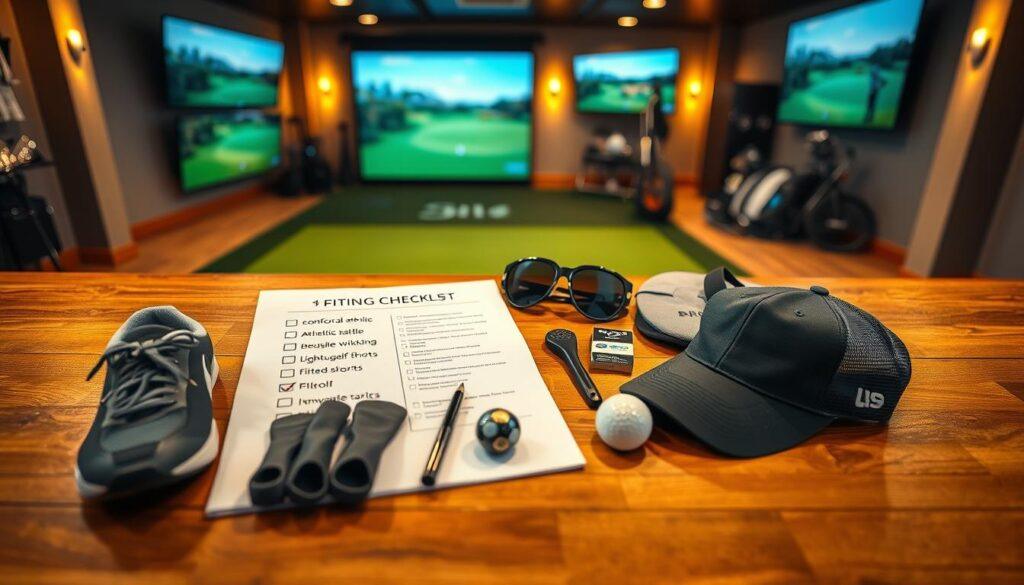
This is about creating a neutral space for your swing. Comfort is key, not a luxury. It’s what lets your swing speak freely.
Now, for the gear. The most important item on your checklist isn’t your wallet or phone. It’s your current golf clubs.
Showing up without your clubs is like not bringing evidence to a crime scene. Your clubs are your baseline. They show your swing flaws and typical misses.
The fitter needs to see your real swing. Not the perfect swing you show off. Your real swing is more valuable for fixing your game.
So, your checklist should include mental prep. Be ready to show your swing’s flaws. This isn’t a review; it’s a detailed check-up.
Let’s talk about money. Talking about budget is uncomfortable. But it’s necessary.
Telling your fitter about your budget is like giving a chef a budget. It ensures you get the best clubs you can afford. Be honest about what you want.
Knowing your budget lets the fitter work within your means. It turns the process into a focused project, not just a wish-list.
Your checklist is simple: wear comfy clothes, bring your current clubs, show your real swing, and know your budget. You’re not being tested. You’re working with a pro to improve your game. Come ready, and you’ll leave with the right gear.
Questions to Prepare
The fitting bay is like a courtroom for your golf game. You need to be both the prosecutor and the witness. This intellectual battle, known as the shop Q&A, turns a simple purchase into a game-changing experience. Without the right questions, you might end up with clubs that are just okay. But with the right ones, you can improve your game significantly.

Don’t just sit back and let the fitter do all the talking. You’re there to have a real conversation. Every question you ask can reveal something about your current setup or show a way to improve. This back-and-forth is where the magic happens.
Your Questions: The Cross-Examination
Don’t ask vague questions like “what’s best?” That’s like asking a chef “what’s tasty?” without getting a real answer. Be specific. Your questions should focus on the trade-offs that different club designs make.
Think like Socrates and prepare these questions:
- “Based on my swing path, what’s the actual trade-off between distance and dispersion with this head/shaft combination?” Every design choice has consequences. A low-spin driver might gain you yards but cost you accuracy. You need to know the exchange rate.
- “How will this specific club help me with my recurring nightmare shot?” Maybe it’s that low, spinning drive that always finds the right rough. Or the iron that balloons into the wind. Name your demon, and ask how this club slays it.
- “If we prioritize forgiveness on my mishits, what performance am I sacrificing on center strikes?” This gets to the heart of game improvement versus player’s clubs. There’s always a compromise.
- “Can you show me the data comparison between my current gamer and this new option, specific on my typical miss?” Launch monitors don’t lie. Make them show you the evidence, not just the best-case scenario.
This isn’t just about asking questions for the sake of it. It’s about understanding the why behind the recommendation. When a fitter says “this shaft is better,” your follow-up should be “better at what, for my swing?”
The Fitter’s Questions: Your Diagnostic
The shop Q&A becomes a true collaboration here. A good fitter will ask you deep questions about your golf life. Your answers will help turn abstract numbers into a clear mission.
Be ready for their questions. They’re not just making small talk; they’re building a detailed profile of you. Expect questions like:
- “What’s the one shot at your home course that haunts you?” This question turns the fitting into a specific problem-solving session. That tricky 210-yard approach over water isn’t just a number—it’s the reason you’re here.
- “Describe your typical miss pattern with your current irons/driver.” Be brutally honest. “I tend to push-fade my long irons” is more useful than “I’m inconsistent.”
- “What physical limitations should I know about?” That old tennis elbow, the stiff back in the morning, the shoulder surgery from college—these aren’t secrets to hide. They’re key data points that affect shaft weight, flex, and even grip size.
- “What conditions do you usually play in?” Windy coastal links require different specs than calm parkland courses. Your equipment should match your battlefield.
- “What’s your golfing background, and what are your realistic goals for this season?” Are you a former college player trying to regain form, or a weekend warrior hoping to break 90? The answer dictates everything.
The most insightful fittings happen when both sides are fully engaged. You’re exploring the technology’s limits; they’re exploring your game’s contours. This two-way street of inquiry transforms the process from buying a club to being fitted for a solution.
Remember: the right question at the right moment can reveal more than an hour of ball flight data. Your prepared shop Q&A script is your most important club in the bag—even before you swing a single new iron.
Maximizing Value
You’ve figured out the logistics. Now, the real magic is in your mind. The most valuable tip isn’t about your swing; it’s about your mindset.
Walk in without any brand bias. Your fitter doesn’t have one either. The best tips often suggest trying a hybrid when you thought you wanted blades. Think of Fred Couples. His swing is smooth, yet he uses hybrids. Your ego is like a custom shaft you can’t afford.
Fitting is about optimizing, not making it perfect. You might choose accuracy over distance. For the player facing a tough par five, that’s a win. Value depends on the situation, not just numbers.
This change in thinking needs a system. Like turning leads into customers, fitting needs a process. Use appointment tips that stress shared responsibility and clear schedules. Apply this to your fitting too.
The real gain isn’t just on your clubs. It’s the confidence in your game and the joy of playing. That’s the best tip. Now, go use it.