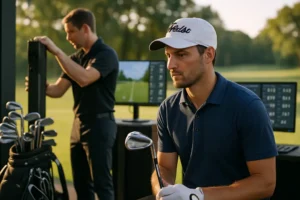
TrackMan Club Fitting gives a new golfer a clearer way to see what the ball and club are doing, but the value is not in one eye-catching number. The value is in patterns: carry distance, ball speed, launch, spin, face behavior, and how those readings change across a set of shots.
That matters because most players arrive at a fitting with two problems. First, they remember their best shot better than their normal shot. Second, they often judge a club by feel before they know whether the ball flight supports it. A launch monitor does not remove the fitter’s eye, but it gives the fitter evidence to test against what the player feels.
Why TrackMan Club Fitting Starts With Ball Flight
TrackMan has become a serious reference point in elite golf because it measures both club and ball data. The PGA TOUR renewed its TrackMan agreement in August 2025 through 2030, and TrackMan tracking units are used with ShotLink, a system described by the TOUR as combining 150 4K cameras and 36 radar tracking units to capture ball-in-motion data during Signature Events PGA TOUR report.
For an amateur fitting, that does not mean the same stakes or the same setup. It does mean the technology has a real place in serious performance measurement. The better question for a player getting started is not, “Is this number impressive?” It is, “Is this number stable enough to help choose a club?”
TrackMan Club Fitting Metrics To Trust First
A fitter should usually begin with the readings that hold up best across repeated swings. Carry distance, ball speed, and clubhead speed tend to be easier to interpret than a single spin reading or one face-to-path number. Those core numbers help answer basic fitting questions: Does this driver head launch the ball in a playable window? Does this iron create a predictable carry gap? Does this shaft help the golfer return the club in a repeatable way?
A TrackMan Club Fitting should start with a stock shot, not a forced maximum. If a player swings harder just because the screen is on, the data can describe the test swing rather than the golf swing. That is where an experienced fitter slows the session down, removes obvious mis-hits from the decision, and looks for a pattern the player can take to the course.
What Elite Use Does Not Prove
Tour-level use does not prove that every amateur needs the same fitting plan as a tour player. It also does not prove that a launch monitor can promise lower scores or longer drives. Equipment can support better launch, better gapping, or tighter dispersion for a given player, but the result still depends on strike quality, swing delivery, practice, and course decisions.
The practical lesson is simple: use TrackMan as evidence, not as a scoreboard. If two driver heads produce similar ball speed, the better fit may be the one with tighter carry spread, safer miss shape, or a launch and spin pairing the golfer can repeat under normal tempo.
Reading Reliable Data Without Overreacting
The strongest fittings separate dependable signals from noisy readings. A PubMed-listed study of high-level golfers using TrackMan 4 indoors reported excellent reliability for several driver metrics, including clubhead speed, ball speed, and carry distance. The same research also found that spin rate and some finer measurements showed more variability TrackMan 4 reliability study.
That finding fits what good fitters already practice. The cleanest decisions usually come from a cluster of shots, not one perfect strike. If three different iron shafts all produce similar carry, the fitter may look harder at launch window, peak height, descent behavior, strike location, and dispersion before making a recommendation.
Strong Metrics For A Starter Fitting
For players getting started, TrackMan Club Fitting works best when the fitter explains the numbers in plain playing terms. Carry distance tells you how far the ball flies before it lands. Ball speed shows how efficiently energy reached the ball. Clubhead speed helps separate a speed issue from a strike or launch issue. Launch angle gives context to trajectory. Spin helps explain whether the ball is staying in the air, falling early, or ballooning.
- Carry distance: useful for gapping and club selection because it describes fly distance, not rollout.
- Ball speed: useful for comparing strike efficiency across heads, shafts, and loft settings.
- Clubhead speed: useful for fitting weight, length, and shaft profile without blaming the club for every miss.
- Launch and spin: useful together, because either number alone can mislead.
Metrics That Need More Context
Spin rate, attack angle, dynamic loft, and face-related measurements can be valuable, but they should not be treated as fixed truths from one swing. The research notes above point to more variability in some of those finer metrics, especially across sessions. That does not make them useless. It means they need context: strike quality, club type, ball flight, and whether the reading repeats.
This is why a fitter may avoid chasing a single “ideal” number. A golfer who hits a 7-iron with playable height and predictable carry may not need a dramatic equipment change just because one attack-angle reading looks unusual. The fitter’s job is to connect the number to the shot.
How A Fitter Turns Numbers Into Club Choices
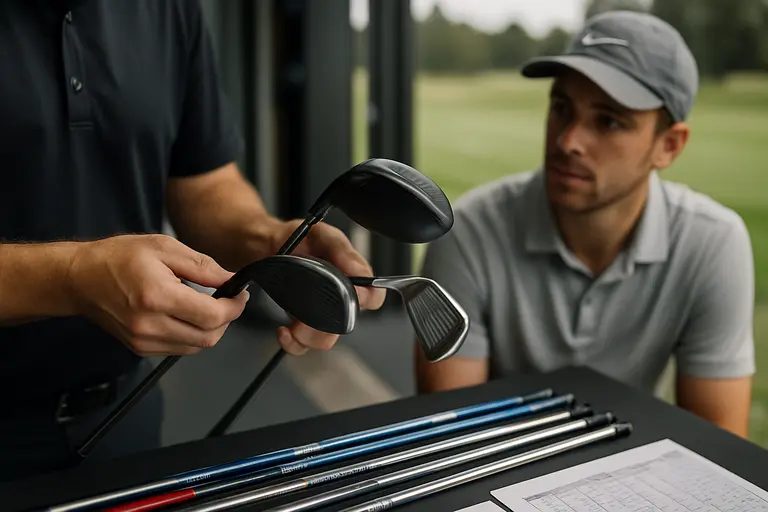
Launch-monitor data becomes useful only after it shapes a real equipment decision. With a driver, that might mean testing loft, head model, shaft weight, and length to see which combination produces the best pattern. With irons, it may mean checking whether the player has consistent carry gaps through the set. With wedges, it may mean treating launch and spin readings carefully while also watching strike and turf interaction.
If you want a broader primer on which launch numbers tend to matter during a fitting, our related piece on fitting metrics is a useful next step. For readers exploring beyond the fitting bay, the same network that connects sports and travel also includes a site for a related audience, Bass Lake Roadhouse, which covers local interests.
Driver, Iron, And Wedge Priorities
Driver fitting often starts with the largest performance spread because tee shots expose speed, launch, spin, and miss direction. The fitter is trying to find a setup that produces playable distance and a miss pattern the golfer can manage. That is not the same as choosing the longest single shot of the session.
Iron fitting is more about repeatable carry than a one-club distance jump. A stronger loft can make one iron fly farther, but the question is whether the full set still gaps correctly. If a 6-iron and 7-iron start flying too close together, the player has gained a number on the screen and lost a scoring tool on the course.
Wedge fitting is where the fitter should be especially careful with interpretation. Research noted in the supplied material points to stronger agreement for ball-flight parameters than for some clubhead orientation and path measurements, particularly with wedges. In practice, that means the shot result, contact pattern, and usable carry windows need to be weighed together.
Session Habits That Keep The Data Useful
A good session does not need to feel like a lab test. It needs enough consistency for the data to mean something. The player should make normal swings, take brief breaks when speed or contact drops, and tell the fitter when a club feels too heavy, too light, too long, or hard to square. Feel is not the whole answer, but it is part of the evidence.
The best fitting conversations sound specific. Instead of asking, “Which club is best?” ask, “Which one gave me the most reliable carry?” or “Which head kept my miss playable?” That moves the fitting away from buying hope and toward choosing equipment based on repeated results.
TrackMan Club Fitting Takeaways For New Golfers
The starter lesson is to trust patterns before peaks. TrackMan can show impressive detail, but a beginning golfer should focus on the numbers that repeat and the ball flights that match real course needs. Carry distance, ball speed, clubhead speed, launch, and spin are not separate stories. They are pieces of the same shot.
Used that way, TrackMan Club Fitting is less about chasing a perfect number and more about building a better equipment decision. A player leaves with clearer gapping, a better understanding of misses, and a more realistic sense of what the club can and cannot fix. That is fitting-first golf: measure carefully, interpret the data with restraint, and choose the club that supports the swing the golfer can repeat.